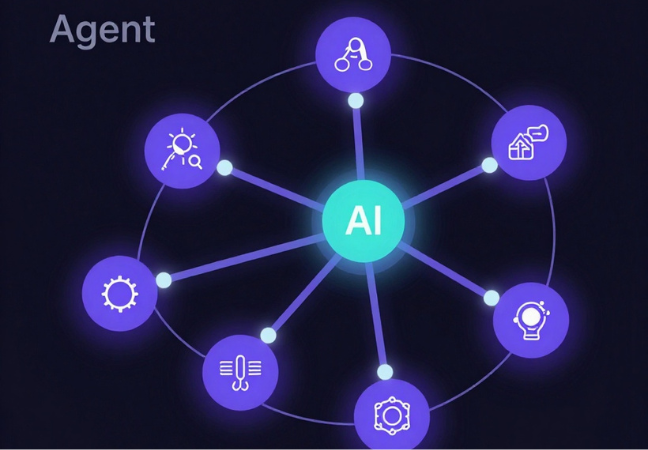
You hired AI. Now AI is hiring its own team.
Businesses were thrilled by AI’s ability to respond to queries a year ago. These days, while you sleep, AI is evaluating contracts, creating code, arranging orders, and reporting problems. The future is not like that. In 2026, that would be Tuesday morning.
Agentic AI is the term for this change. Furthermore, there isn’t just one chatbot in the version that is working hard. It’s a well-organized group of AI agents, each with a job, tools, and the ability to delegate tasks to one another. Consider it more like a tiny department that never clocks out than a vending machine.
What “Agentic AI” Actually Means (Beyond the Buzzword)
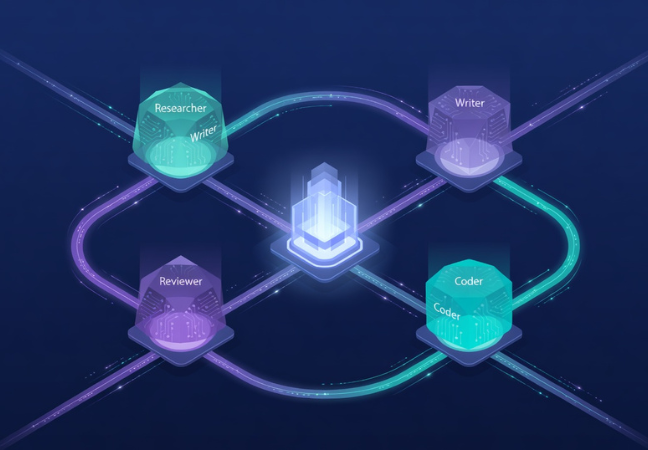
The majority of people still think of AI as a back-and-forth dialogue in which you ask questions, and it responds. That model is totally broken by agentic AI.
An AI agent works in a loop: it sees something, considers it, decides what to do, takes action, and then evaluates the outcome. After one response, it doesn’t end. It continues until the objective is accomplished, or until it collides with a guardrail and requests assistance from a human.
In order to operate independently, adapt in real time, and solve challenging multi-step issues depending on context and objectives, agentic AI mixes several AI agents and makes use of vast language models and reasoning capabilities.
Multiply that by a team now. A single agent investigates a market. A report is written by someone else. A third verifies its accuracy. It is formatted and sent to the stakeholders in a fourth step. The orchestrator was in charge of informing each agent of what the others were doing. That handoff chain is a multi-agent system that takes place in a matter of seconds.
Why One Smart Agent Is Never Enough
The problem with AI agents is that a single agent attempting to accomplish everything is just as ineffective as a single person attempting to do everything. At the limits of its capabilities, it becomes overwhelmed and confused and makes blunders.
The field of agentic AI is undergoing a revolution in microservices. Similar to how distributed service architectures replaced monolithic programs, orchestrated teams of specialized agents are replacing individual all-purpose agents.
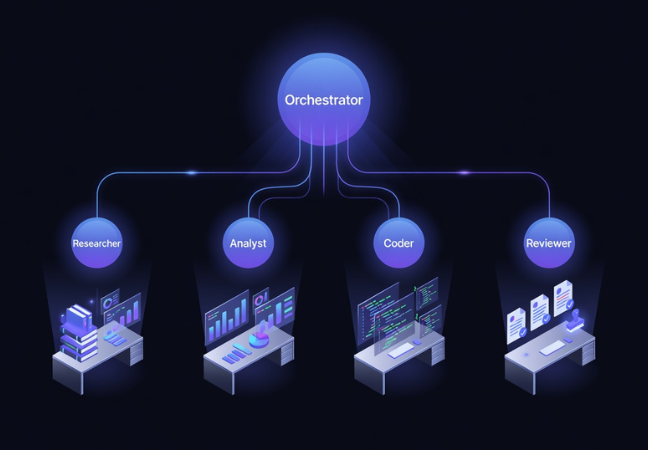
This is how the structure actually functions:
- An orchestrator who divides a high-level objective into smaller jobs.
- Specialized agents: one for writing, one for research, one for code, and one for verification.
- A memory and tool layer that allows agents to surf the web, read files, make API calls, and recall events from five steps ago.
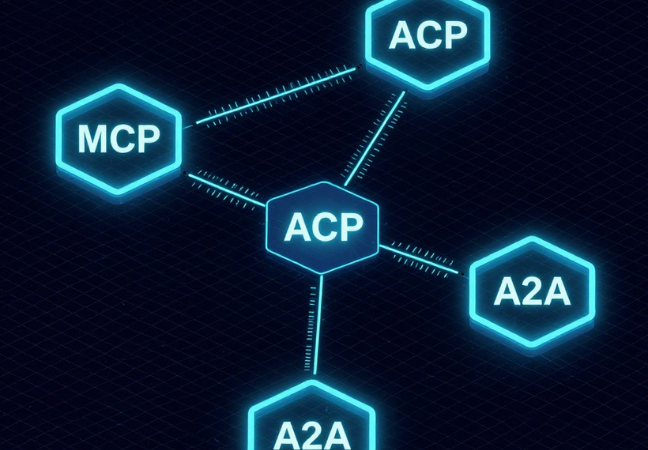
Anthropic’s Model Context Protocol (MCP) eliminates the need for unique integrations for each connection by standardizing how agents access tools and external resources. Google’s Agent-to-Agent (A2A) technology facilitates peer-to-peer cooperation. IBM’s ACP offers enterprise deployment governance frameworks.
In essence, these three open protocols are the plumbing. Because of them, a sales representative from one vendor can now transfer a qualified lead to a CRM-updating representative from another vendor without the need for bespoke glue code.
Real Jobs These Systems Are Doing Right Now

It’s simple to accept the theory. What’s truly taking place in production is as follows:
- Sales pipelines: Without the need for human intervention, an agentic AI system can use CRM data to identify high-intent leads, send customized outreach emails, respond to follow-ups, and even schedule demos. Igmguru
- Supply chains: Several AI agents can cooperate across a supply chain, each offering specialized knowledge, interacting with one another, and working across geographies and disciplines. Together, they can quickly reroute shipments, manage hazards, and modify buyer expectations. MIT Technology Review
- Software development: Tools such as GitHub Copilot Workspace and Claude Code can now read a whole codebase, comprehend its design, write a new feature, create tests, and submit a pull request. The person examines and gives their approval. This is referred to as “repository intelligence” in Anthropic’s 2026 Agentic Coding Trends Report—AI that understands not just lines of code but also their relationships and intent. Medium
- Banking and fraud: Agentic AI in banking can automate credit checks, KYC workflows, and portfolio modifications in addition to temporarily freezing dubious transactions, running layered checks, and intelligently escalating cases. Igmguru
The Part Nobody Talks About: Why Most Deployments Fail
Here’s a real figure: By 2028, AI agents are expected to create $450 billion in economic value, but only 2% of businesses have fully implemented them. Gartner Technology is not the cause of that disparity. The technology is functional. Three elements that most organizations overlook account for the gap:
- Bad data. An agent is only as smart as the information it can access. If your CRM is a mess, your operations data lives in Excel files, and your documents are in someone’s email—your agent will fail in the first ten minutes.
- Automating broken processes. This is the big one. Most companies take their existing, clunky, human-designed workflow and just ask AI to run it. A deep understanding of the business, its weaknesses, and its greatest opportunities for driving efficiency is essential—there is no copy-and-paste approach to deploying multi-agent systems. MIT Technology Review
- No governance. Unlike traditional software that executes predefined logic, agents make runtime decisions, access sensitive data, and take actions with real business consequences—leading organizations to implement “bounded autonomy” architectures with clear operational limits and escalation paths to humans for high-stakes decisions. Juniper Research
What the Human Role Looks Like Now
It makes sense to be concerned that agents will remove jobs. The real world is more fascinating. The role is moving upward rather than downward.
People are taking on the role of supervisors of agent teams rather than carrying out duties. They manage the edge cases that the agents escalate, create targets, establish boundaries, and evaluate the results of high-stakes decisions. It’s the distinction between a production manager and a worker on the factory floor.
While engineers are progressively automating key activities, analysts are being given more authority to create and oversee pipelines. As automation develops, engineers will be able to handle larger systems with fewer resources. IBM
The engineers who create the most code are not the ones who will win in 2026. They are the ones who are capable of organizing, managing, and enhancing agent teams.
Where to Start If You’re Not Already Moving
Here’s the straightforward beginning point if you’re assessing this for your company:
- First, fix your data. Consider whether an AI can truly read the systems it requires to function before creating a single agent. If not, your first week’s assignment is that.
- Select a single, high-frequency, limited workflow. Not to “automate customer service.” A phrase such as “route inbound support tickets and draft the first response” is little visible and reversible.
- Describe what a human review looks like. Checkpoints are necessary for every agentic system. Know ahead of time which decisions require human approval before the agent takes action.
- Measure it. By starting with a single low-risk process, testing it against real workflows, and scaling based on actual outcomes, organizations implementing multi-agent systems today are creating competitive advantages that compound over time. Gartner
The Final Score
There won’t be any agentic AI. It is present. Organizations that view it as a future consideration are already lagging behind those that discreetly automate their most costly, time-consuming, and repetitive procedures.
The technology is advanced. The procedures are uniform. The frameworks are prepared for production. The only real question that remains is whether your teams and workflows are prepared to collaborate with agents who never stop, never forget, and never gripe about Monday mornings.
We recommend checking this detailed guide for more clarity: Agentic AI
You can also read our detailed guide on this topic: How AI Really Learns: The Unspoken Truth About Machine Learning
2 thoughts on “Agentic AI in 2026: How Multi-Agent Systems Are Quietly Replacing Human Workflows”