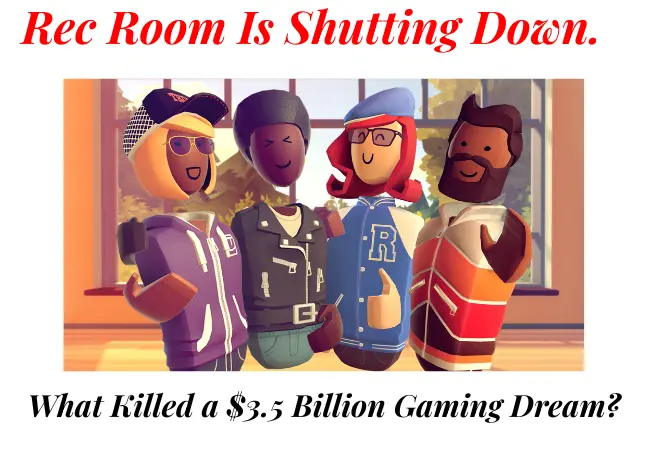
 It had 150 million players, $294 million in funding, and the trust of some of the world’s biggest investors. So why couldn’t Rec Room make money, and what can every founder learn from its downfall?
Imagine creating a product that is truly used by 150 million people. Players may make games, socialize with strangers, and spend real money in this virtual environment. You raised about $300 million from some of the world’s most astute investors. At its height, your firm was valued at $3.5 billion. Then, on a Monday afternoon, you publish a statement stating, “We never quite figured out how to make Rec Room a sustainably profitable business.”
On March 31, 2026, Seattle-based Rec Room announced that it would permanently close its platform on June 1 at noon Pacific. The gaming community was taken aback by the news. In the hopes that it was an early April Fool’s joke, users swarmed the company’s Discord channel. It wasn’t.
This is more than simply a heartbreaking tale of a cherished app going dark. It’s a master class in how profitability and popularity are two whole distinct sports and how even the most well-funded firms may utterly misunderstand them.
“Our costs always ended up overwhelming the revenue we brought in.”
— Rec Room’s official shutdown statement, March 2026
From a Garage Idea to a Billion-Dollar Platform
Nick Fajt, Cameron Brown, and a small group of co-founders established Rec Room in 2016 under the moniker Against Gravity. Building a cross-platform social place where anybody could develop games, share virtual experiences, and hang out on their phone, console, PC, or VR headset was their straightforward yet ambitious notion.
The time seemed ideal. VR was becoming more and more popular. The popularity of social gaming was booming. Additionally, Rec Room offered something that neither Roblox nor Fortnite had fully mastered: it felt more like a true social experience than a game with chat thrown in.
The Pandemic Boom Was Both a Gift and a Trap
Rec Room’s user base skyrocketed in 2020 after COVID-19 forced everyone indoors. People were in dire need of social interaction, and virtual worlds provided an unexpectedly fulfilling alternative. The number of players in the firm skyrocketed. Investors became enthusiastic. Valuations increased dramatically.
The issue that no one wanted to publicly state, however, is that epidemic growth was borrowed growth. Many of those reticent virtual socializers returned to in-person get-togethers as soon as the globe reopened, and the game market’s gains from the epidemic began to reverse. Rec Room’s pricing structure and fundraising presentation were predicated on growth figures that would never become the new standard.
Key Insight
Pandemic-era growth caused many gaming companies to over-hire and over-invest, locking in expenses that the post-COVID market could no longer support. Rec Room was far from alone — but it was among the hardest hit.
The Economics of User-Generated Content: A Beautiful Trap
This is when the narrative of Rec Room becomes quite fascinating and educational. The business made a creative way to wager on user-generated content (UGC). The concept is to let your community create the games while keeping a portion of the profits. For Roblox, it was a huge success. Why not the Recreation Room?
In achingly candid public posts, CEO Nick Fajt provided the solution. When compared to first-party material, the margin on user-generated content was quite narrow.
Consider the practical implications of it. The corporation only received thirty cents for each dollar a player spent on a creator’s game inside Rec Room. Apple, Google, Sony, and other companies receive their required portion from platform fees. Then, if you want talented artists to continue creating, they must be adequately compensated. What’s left is insufficient to support cloud infrastructure, manage a sizable technical organization, and continue to expand.
UGC income was increasing at a rate of 70% annually as of September 2025. For the first time, all of the creators made over $1 million in a single quarter. Those are headline-grabbing figures on paper. In reality, they concealed a fundamental issue: Rec Room’s low-margin business grew more quickly as it expanded its UGC economy.
Based on the Data
Between 2016 and 2021, Rec Room raised $294 million in six rounds. Despite this war chest, the CEO of the firm stated that if they hadn’t made significant cost reductions, the runway would have run out in a few years. After a huge layoff in September 2025, the number of employees dropped from 310 to about 100.
Growth can hide a bad business model — until it can’t. When growth slows, the ugly math becomes impossible to ignore.
AI: An Expensive Bet That Didn’t Pay Off
The squad didn’t sit still, which is to the Rec Room’s credit. They introduced Maker AI, a program that made it easier for gamers to create games using artificial intelligence. In order to keep people interested in the platform, they introduced Roomie, an AI companion.
The issue? Real money is spent on running AI features, including substantial computational expenses per user that don’t go away just because a feature is popular. Fajt officially admitted that the cost of AI features per user was more than the subscription income, such capabilities were expected to provide. To put it another way, Rec Room lost money each time someone utilized Roomie.
The AI trap: In 2024–2025, many consumer apps bolted on AI features to stay relevant. But AI inference costs money at scale. If your monetization model can’t absorb those per-user costs — or if subscriptions don’t cover them — AI becomes a liability, not an asset.
Two Rounds of Layoffs Weren’t Enough
Rec Room laid off 16% of its employees in March 2025. Although it hurts, many firms have to make this type of sacrifice in order to properly scale. However, a far harsher second wave arrived a few months later, with about half of the remaining team, cutting the number from about 310 to a little over 100.
Fajt presented it at the time as an essential step in the direction of self-sustainability. He said that the business could no longer rely on outside funding and had a runway through 2029. The cuts bought time, and he was correct. However, it seems that there isn’t enough time—or the wrong type of time—to discover a workable solution.
The last statement from Rec Room is noteworthy for its candor: “We spent a long time trying to find a way to make the numbers work.” “A long time” implies that this was not an impulsive choice. For months or more, the team was aware that the math was flawed. Rather than waiting until the funds just ran out, the shutdown was purposefully planned while there was still enough money and stability to manage it wisely.
“We made the decision now while we still have the ability to wind things down thoughtfully and do right by the people who built this with us.”
— Rec Room shutdown announcement, March 2026
What Happens to 150 Million Players?
This has a genuine human cost that extends beyond the workers. Rec Room was a community, not simply software. Within it, thousands of developers created games, made money, and discovered their creative selves. Only in virtual rooms could players form acquaintances. A few of those connections were just as significant as anything in the real world.
Users have roughly two months to bid farewell due to the shutdown schedule. Subscriptions and new accounts have already been stopped. Purchases of tokens expire on May 1, creator payouts cease on May 18, and the last payment is made on June 1. On that same day, at noon Pacific, the platform itself goes black.
Snap acted swiftly to purchase Rec Room’s assets shortly after the announcement, indicating that at least part of the platform’s technology, intellectual property, or staff would find a second home inside a bigger business. It remains to be seen if that is a continuation or a consolation.
Three Lessons Every Builder Should Take Away
1. A business model is not popular.
The community genuinely loved the Rec Room. 150 million users is a genuine product that real people desired, not a rounding error. However, love doesn’t cover server costs. The difference between “people use this” and “this is profitable” might be huge, particularly if your platform fees and small UGC margins are the foundation of your monetization stack.
2. The Platform Tax Is a Strategy Tax
Rec Room had to concurrently develop on Google Play, Xbox, PlayStation Network, and Apple’s App Store in order to be cross-platform, which led to a continuous loss of revenue. That is a deliberate trade-off, not an accident. But this means that your unit economics have to be built around a thirty-cent dollar from the start, which Rec Rooms never were.
3. Growth That Requires Fundraising Is Fragile
It was simple to raise at extremely high valuations and extend profits into the future throughout the 2020–2021 zero-interest-rate period. The businesses that had not discovered sustainable income were left with costly organizations and no way to break even when interest rates increased, and investor sentiment changed. Rec Room was one of many, but the team’s explanation of the failure was actually unique and valuable.
A Graceful Exit — and a Lasting Question
The way Rec Room handled the conclusion is nearly wonderful. On a Friday afternoon, the founders did not quietly shut down. Users were warned for two months. A final creator reward is being processed. In contrast to the majority of closed companies, they are being open about what went wrong.
The gaming sector will advance swiftly. Other social media sites will make an effort to close the gap. However, it’s worthwhile to consider the question Rec Room raises: Can a purely social gaming platform ever become a viable business in a world where attention is plentiful but monetization is difficult? Or does sustainability always demand either a parent company’s subsidy or a level of commercialization that kills the magic?
We don’t have the answer yet. But we have a very expensive, very honest data point. And in the startup world, that’s worth something.
You can also read our detailed guide on this topic: Agentic AI
We recommend checking this detailed guide for more clarity: Rec Room Shutdown