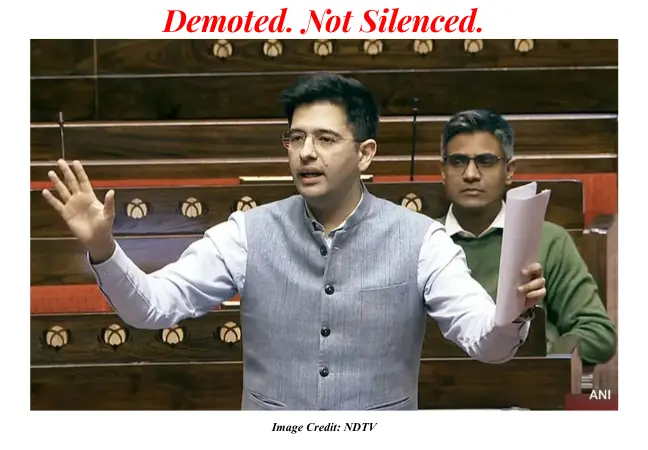
 When a party silences its own voice — Raghav Chadha’s demotion and what it says about AAP today
He was formerly one of the most identifiable faces in AAP. His party then formally requested in a letter to the Rajya Sabha that they refrain from allowing him to speak. What a fall that is.
In India, politics seldom proceeds slowly. However, even by Delhi standards, what occurred to Raghav Chadha on April 2, 2026, was remarkably sudden. Ashok Mittal, a Punjab MP and chancellor of Lovely Professional University, took his place as the AAP’s deputy leader of the party group in the Rajya Sabha. As if that weren’t obvious enough, the party also gave the Rajya Sabha Secretariat official instructions to cease giving him speaking time in the chamber.
This was, to put it simply, a very public slap for a man who joined the AAP at the age of 23, assisted in the drafting of the Delhi Lokpal Bill, became national treasurer at the age of 26, won a state assembly seat, and was regarded as a member of Kejriwal’s inner circle.
What was Chadha’s reaction? Silently, together with a video
He gave a cautious reaction. Not angry, not accommodating. Simply… silent. He shared a video of his recent Rajya Sabha addresses on X (previously Twitter). His removal was not mentioned. Don’t make fun of the party leadership. Nothing dramatic to say. Just go to work.
Letting the work speak is a decision that may be attributed to either a sincere principle or planned cunning. Maybe both. It means that Chadha is not prepared to destroy bridges. Additionally, he isn’t acting as if nothing is wrong. All he’s doing is telling everyone who is watching, “This is what I was doing during all of this.”
In a political culture where press conferences and dramatic exits are the norm, that restraint is notable.
What is actually happening within AAP?
AAP has consistently presented itself as unique, truthful, and a party of the people. However, internal politics seldom align with public perception, and fissures have been seen for some time.
For months, Chadha had been noticeably missing from important party gatherings. When Kejriwal was found not guilty in the liquor policy case, he remained mute. When Manish Sisodia, one of AAP’s most well-known figures, ran into legal issues, he remained silent. Silence in party politics might mean several things. Furthermore, it appears that the leadership of AAP decided to view it as treachery, or at the very least, distancing.
The personal perspective is another. Actor Parineeti Chopra is Chadha’s spouse. His public persona and way of living have become more Bollywood than Bhagidari. Whether it is a fair assessment, it may have been an image issue for a party whose identity was based on austerity and grassroots legitimacy.
The demotion has not been officially explained by the party. In a way, the AAP’s silence is revealing.
But here’s what we shouldn’t lose sight of
Aside from internal party strife, what Chadha was bringing up in Parliament during all of this is the more intriguing tale and the one that genuinely impacts regular Indians.
He posted a video that goes beyond simple political publicity. It highlights actual problems that the Rajya Sabha seldom ever gives any attention to. They deserve more than a list of bullet points, so let’s have a thorough conversation about them.
The 28-day recharge problem
Although it may seem insignificant, hundreds of millions of individuals are impacted by this. In India, most mobile recharge plans are priced for 28-day cycles rather than 30 or 31. This implies that instead of paying for 12 “months” of service in a calendar year, you pay for about 13, with no corresponding advantage, which adds up to almost a whole extra month of fees per year over time.
Chadha suggested that unused data be carried over and that recharge validity be in line with real calendar months. For years, telecom corporations have secretly profited from this type of consumer protection concern while authorities turned a blind eye. It is important to bring it up in Parliament and to genuinely advocate for structural change.
Gig workers: the unseen foundation of rapid business
Every time you order meals on Zomato or goods on Blinkit, a person on a two-wheeler makes sure it gets there in ten minutes. In addition to earning per delivery, such a worker lacks a provident fund, paid sick leave, a minimum pay guarantee, and official job status.
The gig economy in India has expanded significantly; estimates place the number of workers in delivery-based jobs at over 7 million. However, there is almost no legal structure protecting their rights. Chadha expressed worries about the lack of social security, the demands of the 10-minute delivery model, and poor pay.
This is not a minor problem. The number of workers in this group will only increase as rapid commerce spreads to tier-2 and tier-3 cities. The fact that this is being brought up at all is a positive move, and Parliament has to take the initiative.
Airport food prices
The experience is familiar to anybody who has purchased a sandwich or bottle of water at an Indian airport: once you get past security, a ₹20 samosa costs ₹120. Chadha said that all of India’s more than 150 airports had to have reasonably priced food options in their departure zones.
Although this may appear to be a middle-class grievance, think about the bigger picture. Millions of travelers, many of whom are first-time travelers from smaller cities, use airports as a captive market for expensive food sellers. Once a consumer passes security, there is no competition, no regulation, and no consumer protection. In this case, a policy intervention makes perfect sense.
Bank fines, joint tax filing, and paternity leave
Three distinct problems, each subtly important. Fathers in India are completely at the mercy of their employers because there is no legal requirement for paternity leave. The practice of married couples paying joint income taxes, which is widespread in many nations, might ease compliance and lessen the strain on households with two incomes. Additionally, bank minimum balance penalties unfairly impact low-income account customers, who are frequently penalized just for being impoverished.
These are not glamorous problems. They don’t produce prime-time television. However, these are the type of legal loopholes that subtly make millions of people’s lives more difficult, and they need significant parliamentary attention.
What does Chadha’s future look like?
Chadha is still a member of the Rajya Sabha; he was just deprived of a position, not expelled from the party. His tenure ends in 2028. It will take time to see if he stays in AAP, progressively separates himself, or finally walks on.
He has obviously decided not to escalate. Either he’s showing political maturity, or he’s just biding his time. He has a lengthy political career ahead of him at the age of 37, and the problems he has been bringing up indicate that he has real policy interests outside of party structure.
Ironically, his parliamentary work has garnered more attention as a result of the demotion than it would have otherwise. His Rajya Sabha remarks are now being seen by a larger audience than previously. Being ignored can sometimes be the loudest megaphone available.
The bigger picture
The promise that politics might be done differently led to the founding of AAP. No internal power struggles, no dynastic succession, and no voice suppressing. Voters and party members are increasingly challenged to assess whether that promise has held up over time.
It is precisely the type of internal politics that AAP originally pledged to eschew, such as demoting someone for not being visible enough at press conferences or for leading an excessively flashy lifestyle. Observing a party that previously caused disruptions in the establishment begin to repeat itself is quite depressing.
For the time being, Raghav Chadha appears to have concluded that speaking up in Parliament, on the record, where it truly matters, is the best way to respond to being silenced.
You can also read our detailed guide on this topic: WAR
We recommend checking this detailed guide for more clarity: Raghav Chadha