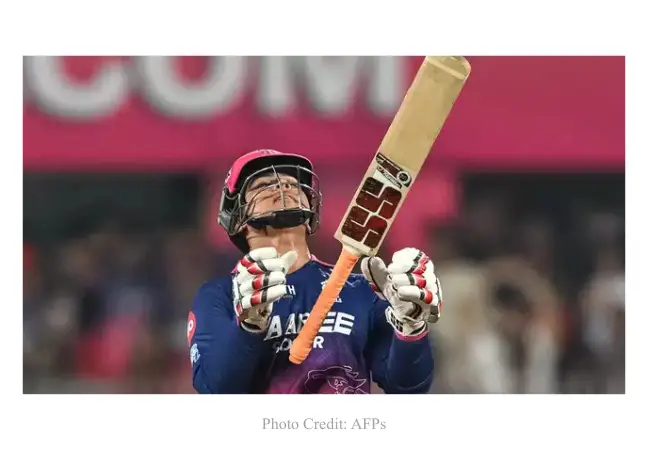
When a 19-year-old hits seven sixes — including some off the world’s best — and his partner keeps perfect pace with him, you’re not watching a cricket match. You’re watching something rare. Friday night in Guwahati was exactly that.
The night the scroll was halted
In what appeared to be a close game on paper, the Rajasthan Royals defeated the Royal Challengers Bengaluru by six wickets after chasing down 202 runs. It wasn’t. The game had already been taken away from RCB by the time Vaibhav Sooryavanshi finished his 26-ball 78.
In IPL 2026, this is RR’s fourth consecutive victory. More significantly, it’s another statement from a squad that now appears to be shockingly well-balanced.
Sooryavanshi: 15 balls, 1 record, no regrets
Let’s get right to it: Sooryavanshi took just 15 balls to reach a half-century. That is the same as his personal record. For background, that’s the speed at which experienced commentators become silent in the middle of a phrase.
The fact that he accomplished it against someone makes it even more amazing. In the third over, Josh Hazlewood, an international bowler with comparable accuracy when bowling short, full, and cross-seam, was dismantled. Each of the four successive scoring attempts went to a different area of the field. a cut behind the point. A powerful drive over mid-on. a cover drive that flows. A flat-batted draw over deep square for six came next.
Variety like that isn’t aggressive. That’s expertise. Young batters often target one or two regions. When facing international quicks as well as net bowlers, Sooryavanshi appears to actually see the ball early enough to choose his location.
One of the most cunning players in Twenty20 cricket, Bhuvneshwar Kumar, almost got him the first ball with a swinging yorker. After digging it out, Sooryavanshi flicked it back for four. He reached fifty by hitting Bhuvneshwar for consecutive sixes in the fifth over. Sooryavanshi is in control in two distinct match scenarios with the same result.
The calm genius seated next to you is Jurel.
The point with Dhruv Jurel is that he made no attempt to outdo Sooryavanshi. He simply batted. And for some reason, he was there, run for run, stroke for stroke, during a power play that yielded 97 runs, the most of the IPL 2026 season.
This innings, Jurel’s hands—more especially, their speed—were his defining characteristic. It wasn’t sheer power when he hit youngster Abhinandan Singh for 4, 6, 4, 0, 6, 4 in a single over. The time was crucial. The sort of stroke that requires years of practice to master was his draw shot from a short ball targeted at his ribs, which he blasted neatly over deep square.
Jurel changed tactics, refining his shot selection rather than playing defensively, after Sooryavanshi dropped in the ninth over and Krunal Pandya momentarily threatened to make things interesting. He batted calmly over a quiet period before finishing undefeated on 81 off 43 balls. His and Jadeja’s 68-run partnership put RCB far out of the game.
The third slot in the RR batting order is no longer problematic. It’s Jurel’s.
What RCB did well and why it wasn’t sufficient
To be fair, RCB didn’t disintegrate. Rajat Patidar took his time at first before picking up speed in a calm, mature knock of 63. He demonstrated why he is a big-match performer with the two sixes he smashed off Nandre Burger in the fifteenth over: one was a lofted drive, and the other was a wristy pull off his ribs.
After his partner Phil Salt was sent back for a golden duck off a blazing bouncer, Virat Kohli also put up a strong fight, hitting Jofra Archer for three boundaries. Venkatesh Iyer, a late-arriving impact player, hit 29 off 15 balls to help RCB surpass 200.
The issue? When Sooryavanshi was at the crease, 201 runs on a level Guwahati deck—the type of surface where the ball comes on well and boundaries don’t need heroics—was just insufficient. Throughout the entire inning, RCB hit seven sixes. On his own, Sooryavanshi scored seven. The gap is that.
It also backfired to activate Venkatesh Iyer as an impact player instead of Suyash Sharma, a specialist spinner. Knowing that they were a spinner light, RR played appropriately, persevering through the slower middle overs without panicking since they knew the odds were always in their favor.
Why the RR machine is the team to defeat. Four victories out of four, this is what truly frightens me about this RR side:
- Sooryavanshi’s top-order firepower allows him to win a match in six overs. That is a statistic, not an exaggeration.
- Middle-order calm: Jurel accelerates and stabilizes in addition to scoring. Rarely does a player possess both of these highly distinct abilities.
- Bowling variety: Brijesh’s control, Bishnoi’s cunning, and Archer’s speed. RCB found it difficult to defeat any of them.
- Tactical acumen: The middle order made a wise choice by recognizing RCB’s lack of spinners and batting through it coolly.
The final word
RCB dared to hope when Jaiswal returned to the dugout two overs into the RR chase. It took around two overs, which is how long it takes for Sooryavanshi to alter the course of a cricket match.
The new face of aggressiveness in IPL 2026 is a 19-year-old who knocks seven sixes every game and is improving every time. That’s a fantastic thing to be able to say to RR fans. For everyone else? It’s simply amazing.
Also Read: David Miller and the Single That Wasn’t
We recommend checking this detailed guide for more clarity: Sooryavanshi and Jurel make short work of RCB