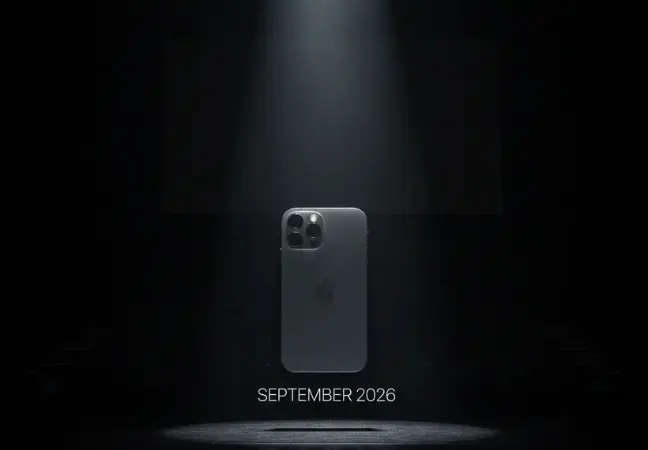
The iPhone 18 Pro series could come in new colours. (Representational image made with AI)
Apple is quietly shrinking one of the most iconic parts of your iPhone screen. Here’s what that really means — and why it matters more than you think.
If you’ve ever noticed that “that black blob in the middle feels a bit large” when looking at the top of your iPhone, Apple might have noticed. According to leaks, the iPhone 18 Pro will have a much smaller Dynamic Island, which is a huge design shift. No, beauty isn’t the only factor here. The ramifications range from the premium Pro models to the anticipated iPhone Fold, and there is actual technology behind it.
Let’s dissect everything, including what is being said, who is making the claims, the reliability of the sources, and the implications for your upcoming update.
Why Does the Dynamic Island’s Size Matter? What Is It?
With the release of the iPhone 14 Pro, Apple swapped out the previous notch for a pill-shaped cutout and covered it with an ingenious software layer known as Dynamic Island. A shape-shifting display element that gives you real-time information, such as music playing, a timer counting down, or your Uber approaching, has replaced the unsightly black hole at the top of your screen.
It was a really clever design choice. However, physical space is still necessary. The front camera and the Face ID sensor array, a group of sensors that scan your face in three dimensions, are located beneath the black cutout. The cutout must be greater if those components are larger.
Thus, what leakers really mean when they say that the Dynamic Island is getting smaller is that Apple has succeeded in making the hardware behind it smaller. That story about engineering is more interesting.
What’s Behind the Leaks
The Report on the Ice Universe
The iPhone 18 series will have the same general bezel design as the iPhone 17, with the exception of a smaller central Dynamic Island, according to Ice Universe, a well-known Weibo leaker with a strong track record for Apple forecasts.
In simple terms, this is the essential quote: the pill at the top becomes smaller, while the bezels remain the same size. That’s actually rather detailed, and it eliminates the possibility that Apple is redesigning the entire screen this year.
A smaller cutout means less screen real estate lost at the top. You get a more usable display without Apple redesigning the entire front panel. It’s a refinement, not a revolution — but a meaningful one if you use your screen a lot.
The Initial Leak of Apple Photos
At about the same time, an account named Early Apple shared what looks to be an authentic image of an iPhone screen. A much smaller Dynamic Island can be seen in the middle of the picture, with a circular glow illuminated by the phone’s flash to the left of it. If the circle is real, it may be that the Face ID sensor moved beneath the screen.
For years, there have been rumors of under-display Face ID. The most space-consuming sensors are now concealed behind the screen itself, which would explain why the cutout may get smaller if Apple has finally succeeded.
Do Several Leaks Equate to Truth?
Not by default. However, trust is increased when two distinct sources, employing disparate approaches, reach the same conclusion. It may have been photographed by Early Apple; Ice Universe described it. Even if neither leak is verified, that alignment is significant.
Why You Should Be Wary of the “Nano Island” Claim
The situation was somewhat complicated by a third source. Apple will rename the smaller Dynamic Island the “Nano Island,” according to an X account named @MajinBuOfficial (notice the lowercase “i” at the end, which is strangely similar to but distinct from the actual Majin Bu account).
This one is worthy of a hefty dose of skepticism. This is the reason:
- The name of the account is incorrect. The classic warning sign for impersonation accounts is MajinBuofficia, which is the absence of a letter.
- The name defies Apple’s reasoning. “Dynamic” Island gets its name from the way it shifts in both form and purpose. Simply because it is smaller, calling it “Nano” ignores the whole purpose of the feature.
- Apple seldom renames mature features. Over the course of three years, they made modifications to the Dynamic Island’s software. Wholesale rebranding would confuse current consumers and weaken their established brand identification.
Has the size changed? Most likely genuine. The name “Nano Island”? Most likely not.
Which iPhones Will Get the Smaller Dynamic Island?
This is where things get a little fuzzy. Based on what’s been leaked so far:
- The smaller Dynamic Island—possibly with under-display Face ID—is most likely coming to the iPhone 18 Pro and Pro Max.
- The iPhone 18 (regular model) is also anticipated to receive the update, although there is now less assurance because it will come later, probably in the spring of 2027.
- The iPhone 18e seems doubtful. The previous generation’s design is usually used for Apple’s “e” (cheap) series. It won’t be as good as the Pro, but it will likely improve over what the 17e had.
- Unknown but most likely not is the iPhone Fold. According to reports, the Fold won’t even have Face ID since the sensor array is too big for its thin, folding design. For that model, Apple could switch back to Touch ID, which is unexpected considering how much they’ve supported Face ID security.
Bloomberg’s Mark Gurman has reported that the iPhone Fold will use Touch ID instead of Face ID. The reason: the Face ID sensor array is simply too thick for the svelte profile Apple is targeting. For a device expected to be the most expensive iPhone ever, reverting to Touch ID is a strange trade-off — and one that Apple will need to explain clearly.
Why This Change Is Actually a Big Deal
A smaller cutout can be easily written off as a simple aesthetic change. However, consider what it really means:
- The technology for under-display sensors is developing. Apple has resolved a long-standing technical challenge with the Face ID hardware that is moving beneath the screen. This opens the door for future iterations of the iPhone to have a real full-screen display.
- A larger screen without a larger phone. Apple is only reclaiming space that was previously taken up by the sensor region rather than making the iPhone 18 Pro substantially bigger.
- Not only does Dynamic Island become smaller, but it also gets smarter. Apple has greater flexibility to enlarge the Dynamic Island when it wants to display current information and reduce it even more when it doesn’t, because the cutout takes up less screen real estate.
Is It Time to Upgrade from an iPhone 16 or 17?
The answer is most likely yes if you’re using an iPhone 15 or earlier; the iPhone 18 Pro is a significant upgrade due to the combined modifications (camera, processor, and display). It depends on how much the Dynamic Island annoys you on a daily basis if you’re using a 16 Pro. After a week, most people hardly notice it.
Is your device a 17 Pro? Most likely, the design modification is insufficient on its own. Let’s wait and see what else Apple reveals in September.
The Final Score
The iPhone 18 Pro appears to be the most sophisticated iPhone that Apple has produced in years, not because it is larger but rather because it makes better use of what is currently available. It seems like a minor upgrade to have a smaller Dynamic Island. However, it probably indicates that Apple has now figured out how to conceal Face ID behind the screen, which alters the long-term course of iPhone design. September will arrive sooner rather than later.
You can also read our detailed guide on this topic: Rec Room
We recommend checking this detailed guide for more clarity: iPhone 18