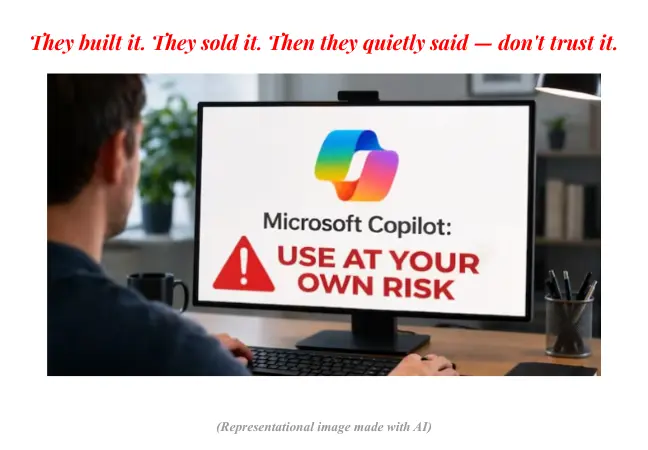
Microsoft Says Copilot Is “For Entertainment Only.” So, Why Is It Running Your Office?
Let’s imagine your business purchases a hammer with the warning, “Don’t use this for serious work.” Microsoft subtly included that in its Copilot Terms of Use, and hardly anyone saw it.
The statement “Copilot is for entertainment purposes only” is buried in an October 2024 amendment to the official Copilot agreements, and it should cause any corporate user to stop. It might not function as planned and cause blunders. Copilot should not be relied upon for critical guidance. Use Copilot at your own peril.
Meanwhile, Microsoft is spending billions convincing you Copilot is the future of work – integrated into Windows 11, Microsoft 365, and a new generation of Copilot+ PCs engineered particularly to run AI quicker. Something doesn’t add up.
The Fine Print Nobody Reads
To be fair, this kind of disclaimer isn’t new. Every major AI company has some version of it. xAI, the company behind Grok, warns that its AI can produce “hallucinations,” may be “offensive,” and might “not accurately reflect real people, places, or facts.” OpenAI, Google, and Anthropic all have similar language somewhere in their legal documents.
These disclaimers exist, in large part, to protect companies from lawsuits. If your AI-generated legal brief turns out to be completely fabricated, the company wants a paper trail showing they warned you.
“Entertainment purposes only” is the legal equivalent of writing “objects in mirror are closer than they appear” — technically honest, practically ignored.
This is where Microsoft’s situation is particularly problematic, though: no other AI firm has aggressively pushed its product into workplace and productivity environments as Microsoft has done with Copilot. While OpenAI offers ChatGPT and Google has Gemini, Copilot is integrated into Word, Excel, Teams, Outlook, and the Windows taskbar. It’s not a stand-alone chat program. It is integrated into the equipment that millions of people use on a daily basis to perform real job.
What “Entertainment Only” Really Means and Doesn’t
Let’s read Microsoft fairly. When they mention “entertainment purposes,” they most likely don’t imply that you should limit your usage of Copilot to creating memes or stupid poetry. In legalese, what they essentially imply is that your business shouldn’t wager on this without first reviewing its work.
That message makes sense. The way it conflicts with marketing is the issue. Advertisements for Copilot+ PCs depict individuals confidently doing tasks more quickly, making wiser choices, and creating flawless papers in a matter of seconds. This is your competitive advantage, according to the tone. Don’t trust it for anything significant, according to the tiny print.
Both things can technically be true at once. AI can be genuinely useful for productivity and unreliable enough to require constant human verification. But most people won’t hold both ideas in their head at the same time — especially when billion-dollar marketing campaigns are reinforcing only one of them.
Actual Repercussions: When AI Is Over-Trusted
This is not a theoretical issue. The consequences of over-trusting AI in work environments are already being observed.
The Story of the Amazon Outage
There have been reports that certain AWS outages were caused by engineers allowing an AI coding assistance to fix problems without enough human supervision. Changes made by the AI with assurance and without hesitation resulted in what were internally referred to as “high blast radius” occurrences. To disentangle the damage, senior engineers had to be called into emergency meetings.
Consider the term “high blast radius.”That’s not an issue with entertainment. The over-reliance on AI output is directly responsible for that real-world infrastructure disaster.
Attorneys Citing False Cases
The practice of attorneys presenting AI-generated pleadings with hallucinated case citations—cases that just don’t exist—written by ChatGPT with the assurance of a tenured professor has become well recognized. Attorneys have been penalized by judges. Cases have been rejected. reputational harm. All because the output was trusted without being verified.
These are not examples of edge cases. They are indicators of the emergence of a much bigger pattern.
Automation Bias: The Psychology Issue
The fundamental problem is that it affects everyone, including those who are aware that AI is fallible.
Automation bias is the term used by psychologists to describe people’s well-established propensity to over-trust machine outputs, even when they are aware that computers might make mistakes. It’s the same reason doctors may overlook a tumor after an AI scan yields negative results, or why pilots occasionally fail to question autopilot warnings until it’s too late.
Why This Is Important
You don’t have to be foolish to be affected by automation prejudice. Experts, skilled professionals, and those who are completely aware of the limitations of the technology experience it. Particularly when time is of the essence, the brain tends to trust an output that appears assured.
One particular way that AI exacerbates this is that it doesn’t appear unsure. A language model produces both incorrect and correct answers in the same typeface, with the same authoritative structure and confident tone. There’s no verbal or visual clue that indicates, “I made this up.” It simply seems like a really intelligent individual providing you with an excellent response.
Because of this, even while the “entertainment purposes” disclaimer is legally sound, it could not truly protect the most vulnerable individuals—those who blindly believe the product.
The Contradiction’s Business Model
This is not an accident. The amount of money that tech corporations have invested in AI infrastructure is astounding; Microsoft alone has spent tens of billions on OpenAI and its own AI development. Adoption provides the necessary returns for that investment. rapid and extensive adoption.
Therefore, there is institutional pressure to publicly promote AI capabilities while discreetly revealing their limits. The current state of the economy necessitates it, not because these businesses are malevolent. Investors want to see an increase in AI engagement every quarter. AI is the growth narrative on every earnings call.
This makes a space between:
- What AI is supposed to accomplish (replace tiresome chores, increase productivity, and offer you an advantage)
- What AI is legally defined as doing (entertainment, at your own risk, with no promises)
Microsoft is hardly the only company with this disparity. However, as Copilot is now the most integrated AI solution in workplace computing, Microsoft’s argument is the most prominent.
How to Use AI Tools Effectively Without Getting Burned
This does not imply that AI tools are worthless. When it comes to writing, summarizing, brainstorming, explaining, and expediting specific kinds of work, they are frequently quite exceptional. The secret is to recognize their shortcomings and develop routines that address them.
A report written by a copilot is not the same as one that is completed, thus use AI output as a first draft rather than a finished solution. It is a place to start. Examine it critically, just as you would an intern’s first week of work—talented but unproven.
Never neglect to verify the accuracy of certain assertions.
The categories where AI hallucinates most convincingly include dates, statistics, quotations, legal precedents, and product requirements. Before using a number or named source that an AI provides, make sure to independently check it.
Keep an eye on your own psyche
Develop a deliberate skeptical habit. Ask yourself, “Do I really know this is correct, or does it just sound correct?” before accepting an AI result that seems correct. Any disclaimer a business includes in its terms of service is not as valuable as that one inquiry.
Start by using AI for low-stakes activities.
Develop trust gradually. Use AI tools for activities where errors are inexpensive and simple to detect; when you get a sense of where they function well and poorly in your particular workflow, you may extend.
The Final Score
It’s not inherently dishonest for Microsoft to refer to Copilot as an “entertainment” tool in its fine print while spending billions promoting it as a productivity breakthrough; both may coexist.
However, Microsoft’s stockholders are not the ones who will bear the cost of that paradox. They are the engineers who blindly accept the AI’s code repair. The attorney who submits the brief using fake citations. The analyst who submits a report based on data from hallucinations.
There is a disclaimer. The majority won’t read it. And even those who do frequently allow automation bias to take precedence over their better judgment when a confident-sounding response comes on the screen.
The true danger of AI in 2026 is not that the technology is flawed, but rather that there is a large enough disconnect between how it is marketed and how it functions. Make use of these resources. Just remember to always be the person in the room.
You can also read our detailed guide on this topic: RCB
We recommend checking this detailed guide for more clarity: Microsoft Copilot AI