
Over 80 times a day, the majority of us lock and unlock our phones. We scan through feeds, use applications, communicate, and make video calls. We now know how to communicate in the language of technology. However, what if technology eventually picked up our language?
That is no longer a hypothetical. Six of the largest IT companies in the world are currently competing to develop a new type of device behind closed doors and under strict secrecy. Not a more intelligent phone. Not a more advanced smartwatch. A physical AI companion that lives next to you, listens, and learns is something truly unique. You don’t need a screen.
One of the biggest changes in technology over the last fifteen years is this. Furthermore, the majority of individuals are still unaware of it.
01 / What Is a “Physical AI Device” — Really?
The Idea That Changes Everything

The idea is surprisingly humane when the buzzwords are removed. Imagine having an intelligent, understanding helper at your fingertips. You don’t have to enter a query or log in. They see when you’re running late, remind you before you even consider asking, and assist you in writing that challenging email without being asked.
These gadgets are meant to be like that. It’s not a voice command system that you can yell commands at. Not a speaker-equipped search engine. An AI that truly comprehends context, including your routines, preferences, and habits, and takes independent action.
“The smartphone made the internet fit in your pocket. These devices want to make intelligence fit into your life—invisibly, naturally, without friction.”
What is the major technological advance that enables this? There are two things going on simultaneously. AI models became significantly more intelligent. Additionally, the chips required to run them became significantly smaller and less expensive. It is precisely this combination—intelligence, affordability, and miniaturization—that will enable AI to leave your screen and enter the real world.
02 / Who’s Building What
The Six Companies in the Race
This is not the moonshot of a single firm. The lineup is outstanding, and it’s a simultaneous global sprint:
OpenAI “Atlas” Project.
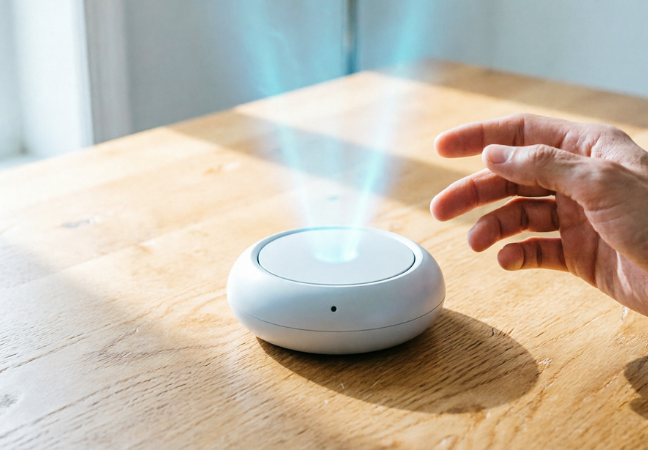
A ChatGPT-based pocket-sized AI gadget without a screen. created by the same designer who created the iPhone, Jony Ive. reportedly replaces a display with voice, sensors, and spatial awareness. Insiders describe it not as a gadget but as a presence.
Apple “Apple Cube”

Next-generation Siri is housed in a glass cube. maintains privacy by processing the majority of AI locally and sending no data to the cloud. According to reports, when the AI is thinking, the prototypes pulse with gentle light. intended to serve as the hub of your whole Apple ecosystem.
Samsung “Samsung Sphere”
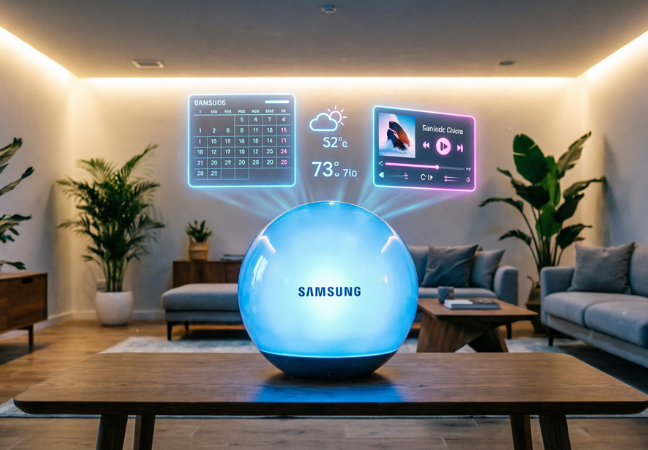
The Sphere, which is based on the Galaxy AI platform, is designed to serve as the center of your house. controls lighting, appliances, calendars, and may potentially use AR-style technology to reflect visual data directly onto nearby surfaces.
Google: Project Without a Name
supported by Google’s massive data infrastructure and powered by Gemini. The idea is to go from “searching” to “asking.” Real-time, context-aware answers without ever touching a screen.
Xiaomi AI Hub
Xiaomi currently offers a wide range of products, including electric scooters, robot vacuums, and phones. An ecosystem of smart gadgets would be controlled by a single intelligent interface thanks to its AI device.
Elon Musk’s XAI: The Grok Device
Probably the most daring wager. A gadget that is linked to Starlink satellite internet, Tesla vehicles, and real-time data from X (Twitter). An AI that is aware of current events in the world, rather than merely providing answers to inquiries.
03 / What Makes This Different from a Smart Speaker?
This Is Not “Hey, Alexa.”
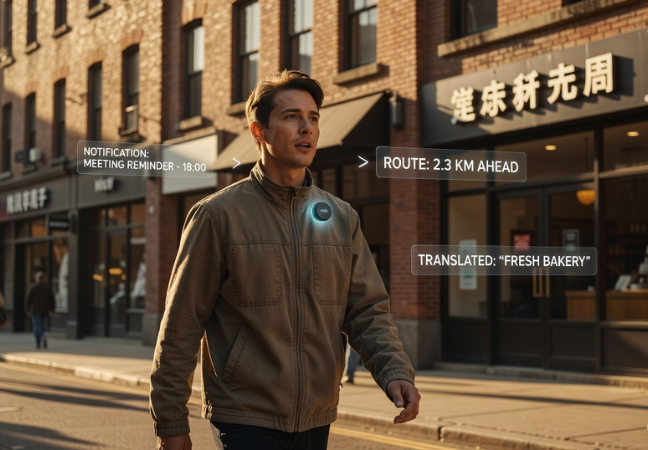
It’s a valid question. For years, we have had Google Assistant, Alexa, and Siri. In reality, what’s new here?
To be honest, those assistants are reactive. You say something, they answer, and then they forget. Every exchange begins with nothing. You have no memory, no sense of who you are, and no capacity to foresee your needs.
These days, proactive devices are being manufactured. Over time, they gather up knowledge. They are aware of trends. Think about what that truly entails in day-to-day living:
- Saying “what’s on my calendar today” is unnecessary because it recognizes that you’re running late and brings up your 9 a.m. meeting when you’re brewing coffee.
- It knows you haven’t had lunch, that you enjoy Thai food, and that there is a restaurant four minutes away, so you don’t need to ask for a recommendation.
- Instead of searching for “how long to roast chicken at 180°C” on Google, it uses its camera to observe the chicken on your counter and simply informs you.
- You don’t have to write your own apologetic email; just specify that you forgot a meeting, and it will subtly compose something suitable for your tone.
This is the “why it matters” section. It has nothing to do with a more intelligent search box. The goal is to eliminate the obstacles that stand in the way of fulfilling a desire.
The Shift in the Core
We adapted to technology for fifteen years, learning how to use apps, navigate user interfaces, and remember passwords. This is completely reversed by physical AI devices. They adjust to us. There is no screen on the interface. You are living your life as the interface.
04 / The Real Concerns Nobody Talks About Enough
Always Listening. Always Watching.
It’s helpful to have a gadget that actually knows you. However, it’s also, to be honest, a little unnerving, and it’s important to acknowledge that.
By definition, a gadget with constant microphones, cameras, and sensors that picks up on your everyday routines, habits, preferences, and emotional patterns is likewise a surveillance device. Whether these items will reveal a lot about you is not the question. They will. Who else will have access to that information? How will it be safeguarded? And what will happen if it contains false information about you?
Some businesses, particularly Apple, are wagering on processing data locally on the device so it never leaves your house. Your most private information is stored somewhere else, as others will depend on cloud servers. These are significant distinctions. These are important decisions regarding the nature of your relationship with your AI partner.
Before purchasing one, consider the following three questions:
- Where does my data really end up—on company servers or on a local device?
- Can I always remove what the AI has discovered about me?
- What happens to my data if the business closes, is acquired, or is hacked?
05 / When Will Any of This Actually Happen?
Realistic Timelines
To be honest, some of this is farther away than you might imagine, and some is closer. According to reports, OpenAI’s Atlas plans to make an announcement in the second half of 2026. This year, Apple’s Cube might make an appearance at its iconic September presentation. By the end of 2026, Samsung is anticipated to conduct closed beta testing.
However, “in your home” and “announced” are somewhat different. It took years for the smartphone to become widely used after it was first announced. These gadgets will probably take a similar route: mainstream later, early adopters first. In all likelihood, the majority of individuals will have one by 2027 or 2028.
The technology that xAI is attempting to combine (Tesla, Starlink, and real-time social data) makes its device the most ambitious and far-reaching. It is also the most difficult to implement.
Final Thought
The Smartphone Had a Good Run
No one is claiming that cellphones will vanish tomorrow. Deeply ingrained habits take time to break, and billions of people rely on them for almost everything.
The problem with history is that paradigm shifts never seem imminent until all of a sudden they seem inevitable. Nobody anticipated that the iPod would be destroyed by the iPhone. After a few years, it finally did.
This race is unique in that there isn’t just one business doing covert experiments. Six significant players from three different continents are coming to the same conclusion at the same time. Usually, that kind of convergence doesn’t occur unless something significant is on the horizon.
The era of AI devices is not assured. These items might fail, overpromise, or run afoul of privacy issues. However, the path is obvious. The funds have been committed. The talent is concentrated.
The next phase of personal technology will be determined by whoever creates the gadget that wins your trust rather than just your interest. The race is on. And it has already started.
1 thought on “Six AI companies to watch—and how their innovations could replace your smartphone”