
The majority of people believe that helium is only used in birthday balloons. The chip industry is aware that losing it would be much more terrible.
As of March 2026, the semiconductor industry is facing a crisis that is so subtle that most people are unaware of it. One of the world’s biggest hubs for helium manufacturing, Qatar’s Ras Laffan industrial complex, was taken down by Iranian drone strikes. The sole maritime route for Qatari helium, the Strait of Hormuz, is now essentially off-limits to commercial vessels. SK Hynix and Samsung are currently in a panic. The rest of us continue to purchase phones and computers without even realizing that the manufacturers that produce their chips are running out of time.
Here’s what’s really happening — and why it matters far more than any headline you’ve read this week.
Why Helium? What Does a Party Gas Have to Do With Chips?

It’s a valid question. Chip manufacturing is powered by electricity, not helium. However, the entire issue is that it performs a vital function during the production process.
Helium is pumped between the wafer and its carrier during the etching process to quickly dissipate the heat produced and keep the silicon wafer from warping or overheating. The entire batch is ruined by even a slight distortion in a wafer at the nanoscale—we’re talking about circuitry thinner than a strand of DNA.
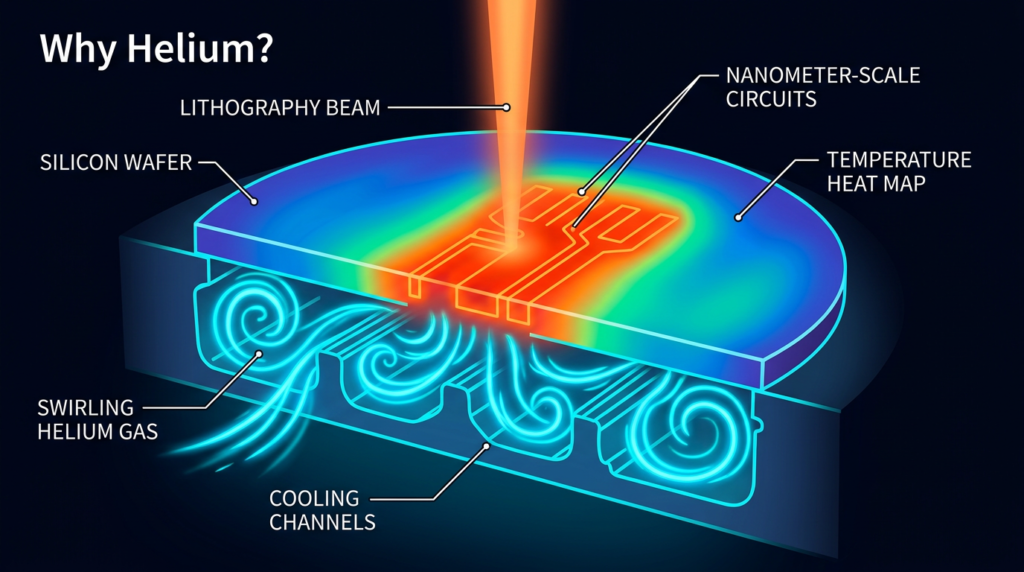
Helium is utilized throughout the chip-making process, from cooling silicon wafers during lithography to removing hazardous chemical residue following cleaning.
It keeps the atmosphere precisely controlled so that nothing undesirable reacts with the wafer in the middle of the operation by acting as a chemically inert blanket around sensitive silicon.
The worst thing is that there isn’t yet a practical substitute for helium for cooling wafers in semiconductor manufacturing, according to Jong-hwan Lee, a professor of semiconductor devices at Sangmyung University in South Korea. You can’t simply replace it. No Plan B gas is kept in a storehouse.
Qatar Was Quietly Supplying a Third of the World’s Helium
The majority of tech workers had never considered the source of helium prior to this catastrophe. They ought to have been listening more intently.

As a consequence of its enormous production of liquefied natural gas, Qatar supplies around one-third of the world’s helium. Following Iranian drone strikes in the early stages of the conflict, QatarEnergy halted production at its vast Ras Laffan facility, the largest LNG export hub in the world. The company declared force majeure on contracts and reduced weekly output from 1.7 million metric tons to just 0.4 million metric tons. That is a significant decline, according to.
That’s not a small dip. That’s a cliff edge.
Since early March 2026, Western commercial shipping has been essentially barred from the Strait of Hormuz, the sole marine export route for helium from Qatar. In just a few weeks, this has eliminated an estimated 27–30% of the world’s helium supply from the market.
To make matters worse, when the conflict started, about 200 specialized containers meant to transport liquid helium were stuck close to the Strait of Hormuz. It might take months to move, replenish, and transport those containers. It was aptly stated by one industry consultant: “There is a tsunami coming, but it’s still a thousand miles offshore.”
Samsung and SK Hynix: The Companies Most Exposed
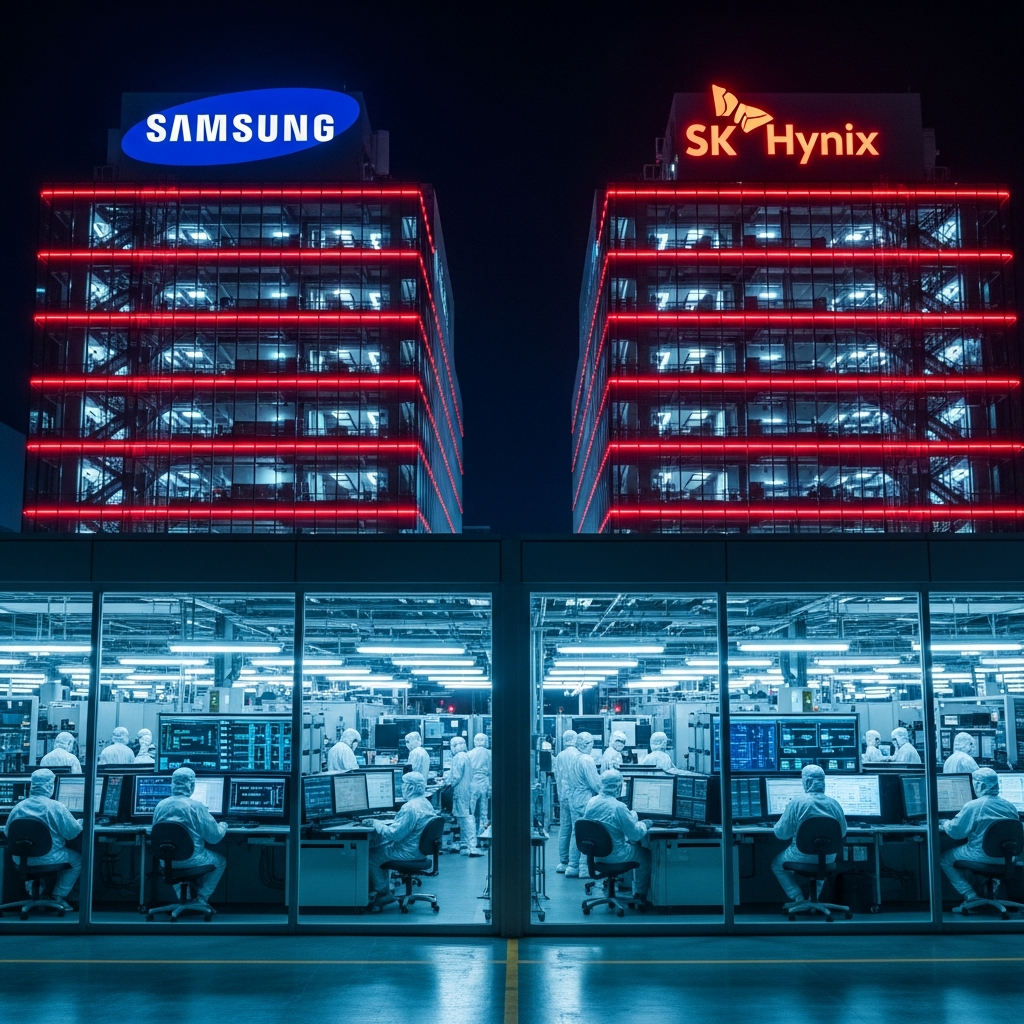
The majority of memory chips produced worldwide are made in South Korea. Additionally, the majority of South Korea’s helium comes from Qatar. At the moment, no one wanted to answer the equation.
In 2025, 64.7% of South Korea’s helium came from Qatar, making local chipmakers at risk if the shortage persists. Together, Samsung and SK Hynix manufacture almost two-thirds of the memory chips used in all smartphones, laptops, servers, and AI accelerators worldwide. These chips include DRAM and NAND flash.
After Qatar halted deliveries, helium prices shot up 40% in just one week. While keeping about six months’ worth of helium reserves, Samsung and SK Hynix are currently rushing to find helium from the US and even Russia.
It sounds comforting to have six months. It isn’t. Helium cannot be securely stored in large quantities at fabrication sites, unlike bulk industrial gases. Most factories have around a week’s worth of working inventory; production relies on constant incoming shipments rather than stockpiles. Imagine a hospital operating on a week’s supply of oxygen tanks and informing the media that it has six months’ worth of inventory in a warehouse across the nation.
The Domino Effect: From Gulf to Your Phone
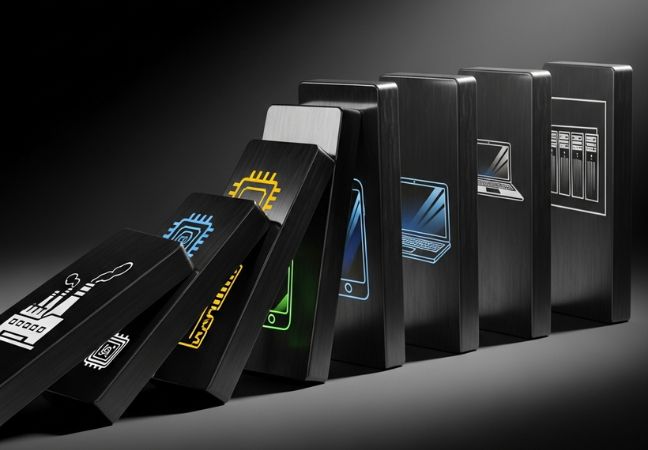
The factory gate is not where the crisis ends. It travels quickly downstream.
Rationing began a few days after Qatari shipments ceased. Fabs start reducing safety stock, prioritize their highest-value production lines, and use less non-critical helium. In Q3 2026, every wafer start that doesn’t occur today turns into a memory chip that doesn’t exist.
To guarantee that their largest orders are completed on schedule, Samsung, SK Hynix, TSMC, and other companies may cut back on the manufacture of less profitable chips. This implies that outdated CPUs, mid-range phones, and inexpensive computers lose priority. The remaining gas is given to the large AI contracts.
Chip prices have already been rising due to manufacturers’ inability to keep up with the insatiable demand for AI. When you combine that with a lack of raw materials, it creates a compounded squeeze that results in lower supply, higher costs, and the most powerful buyers—NVIDIA, Apple, and Microsoft’s Azure—absorbing what’s left.
What Samsung Is Doing Right Now to Fight Back
The major actors aren’t only standing by, to their credit.
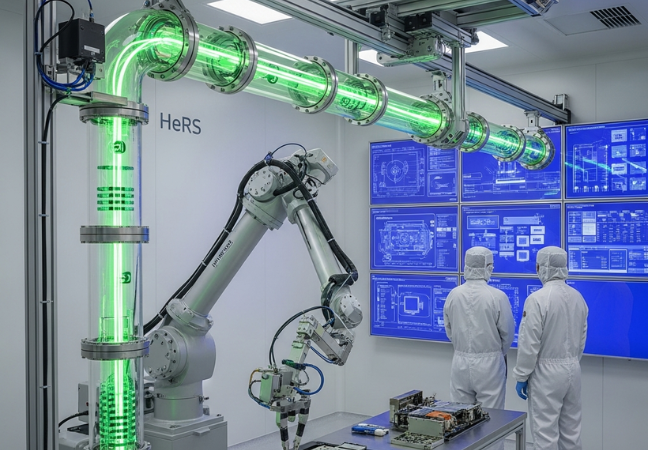
Since April of last year, Samsung has implemented its in-house Helium Reuse System (HeRS) on a few production lines to capture and purify wasted helium for use in semiconductor processes. According to predictions, extending HeRS across all lines could reduce overall helium use by around 18.6% annually, with early results suggesting an annual decrease of about 4.7 tons of helium.
Although that is a significant figure, it won’t immediately counteract a 30% global supply shock. For what is currently a very short-term emergency, it is a long-term solution.
Samsung and SK Hynix are aggressively looking for alternatives, reaching out to U.S. suppliers, the second-largest source globally, and even looking into possible agreements with Russian businesses. The US alternative is feasible but logistically challenging. The Russian alternative is feasible, but working with Russia in 2026 presents a number of challenges.
Restarting LNG production is far from instantaneous, even if the conflict ceased right now. “The process of restarting the LNG plants takes around a month,” stated Kornbluth Helium Consulting president Phil Kornbluth. “It’s not like flipping a switch.” In his best-case scenario, a two-month supply shock may cause four months of market disruption before things return to normal, according to Sherwood News.
Why Nobody Is Panicking Yet — And Why They Should Start

This is the unpleasant reality. Based on what they can observe, markets move. The price of chips hasn’t fallen yet. Production has not yet decreased. Therefore, neither the general public nor many investors have made the connection.
However, supply chain crises operate just like this. A raw material supply cut travels across the chain in a couple of days, in contrast to demand shocks, which develop gradually and give companies time to adapt. In a matter of days, industrial helium spot market prices doubled. When physical supply cannot pass via the shipping route, pre-crisis contracts do not ensure delivery.
Because semiconductor manufacture is given priority over other applications in helium allocation systems, a total halt is improbable. Instead of a complete shutdown, production slowdowns are likely to result in poorer output, greater defect rates, and higher cost per chip.
The truth is that. It’s unlikely that the semiconductor sector would abruptly go out of business. Over the next few months, every gadget and data center on the planet will experience a gradual grind that includes fewer chips, more expensive chips, and longer wait times.
The Bigger Lesson the Industry Can’t Ignore

The semiconductor industry has just been recuperating from the 2021 shortage over the past two years. Billions of dollars were spent by governments on domestic manufacturing. In Arizona, TSMC is constructing. In Texas, Samsung is constructing. The story was, “Never again.”
And yet here we are, undone by a lack of gas that emerges from the earth in Qatar rather than a lack of industries or engineers.
In October 2025, the semiconductor sector surpassed the usage of helium in MRI equipment to take the top spot among all industries in terms of helium consumption. As the sector grew, so did the reliance, and the diversification of that reliance never kept up.
Now, the difficult question is whether this crisis, as terrible as it is, will ultimately compel the industry to create true redundancy. Not only in the location of industry, but also in raw materials, transportation routes, and the unseen inputs that no one considers until they are gone.
Because the next catastrophe won’t reveal itself either. It never does.
You can also read our detailed guide on this topic. Why does war make you Pay More