
When you wake up in the morning and check the news, you see red arrows everywhere: the Sensex is crashing, the Nifty is falling, the rupee is hitting record lows, and headlines are shrieking about war, oil shocks, and the exodus of foreign investors. What does it all truly mean, though, and how did we get here?
- +60% Oil price surge since Feb 2026
- $110-114 Brent crude per barrel
- −6.5% Korea’s KOSPI in a single day
- 12% Average US tariff rate (up from 2%)
Global Markets
The World Right Now
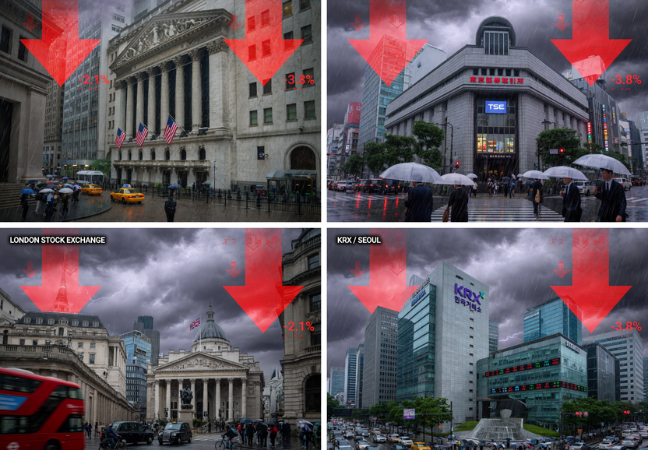
Let’s start by taking a broad view. The global stock markets have had a challenging few weeks. During a trading session, South Korea’s main index dropped by over 6%, and Japan’s Nikkei plunged by nearly 3.5%. The FTSE 100 in London moved into European correction territory. The S&P 500, the most widely watched gauge of the condition of the US stock market, has been declining for the past four weeks and is currently well below its recent highs.
If you’re not familiar with finance, picture a busy marketplace where everything is purchased and sold. For months, the stalls were busy, prices were high, and business was robust. Suddenly, prices are falling quickly, sellers are nervous, and buyers are pulling back. Isn’t it essentially what’s happening in the world’s financial markets?
Trigger #1
A War That Changed Everything

The confrontation between the United States and Iran, which started on February 28, 2026, is the single biggest cause of the current instability. Nearly instantly, the United States’ military actions against Iran had an impact on every aspect of the world economy.
Iran is situated in the Strait of Hormuz, a crucial chokepoint in international trade. This small river is used by almost 20% of the world’s oil. The world’s oil supply was immediately impacted when Iran blocked it. The outcome? In a matter of weeks, oil prices increased by 60–66%, from about $67 per barrel to over $111. Some experts caution that it might reach $150.
Why does the oil price matter so much to you personally? Because oil is the fuel behind almost everything—transport, manufacturing, food supply chains, and electricity. When oil gets expensive, so does almost everything else.
Trigger #2
Tariffs Adding Fuel to the Fire
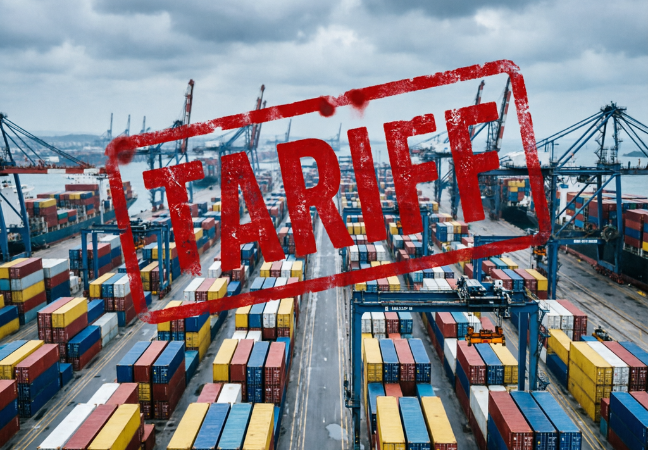
Even before the Iran War started, trade tariffs were exerting pressure on global markets. Under President Trump’s administration, tariffs on a range of imported goods have gone from roughly 2% to 12%. Consider a store that used to buy cheap materials from abroad but now has to pay a sizable additional tax on every shipment. Profitability is harmed by the retailer’s decision to either absorb the loss or pass it on to customers. Either way, someone suffers. When multiplied by millions of people and thousands of businesses, this poses a serious economic dilemma.
Trigger #3
Stocks Were Already Priced Too High
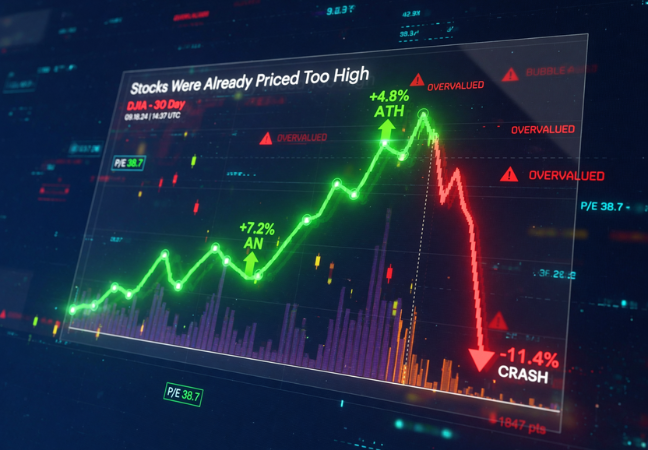
Here’s an uncomfortable truth: even before the war and tariffs, the stock market was sitting at very expensive valuations. The CAPE ratio—which compares stock prices to inflation-adjusted earnings—climbed to around 39. That’s the highest reading since the dot-com bubble of the early 2000s, which burst and wiped out trillions.
India’s Story
Indian Markets
How India Got Caught in the Storm
India is one of the nations most severely affected by this crisis; it is not merely a bystander. Moreover, ₹10.7 lakh crore in investor value was lost in the first few hours of trade on March 23, 2026, when the BSE Sensex fell more than 1,800 points, and the Nifty 50 fell nearly 580 points. Tens of millions of common Indians are witnessing their savings decline in real time, so it’s not a tiny decline.
That day, every major industry—banking, IT, metals, real estate, and consumer goods—bled crimson. Share prices of well-known companies like HDFC Bank, SBI, ICICI Bank, Reliance Industries, TCS, and Infosys fell precipitously. The market as a whole suffers when these heavyweight stocks decline.
India Reason #1
India Imports 85% of Its Oil—That’s a Big Problem
This explains why India is more severely affected by the oil crisis than most other nations. More than 85% of India’s crude oil demand is met by imports. At home, we don’t generate enough. India is therefore forced to pay much more when Brent crude rises above $110 per barrel. This is more than simply a theoretical financial issue. It implies:
The cost of gasoline and diesel increases. The cost of your grocery delivery, your daily commute, and your auto-rickshaw ride all increase. The bill for imports rises. India’s trade deficit is growing, indicating that we are spending a lot more money outside than we are bringing in.
The rupee depreciates. The demand for dollars increases when India must spend more money on oil, which causes the rupee to decline. The rupee fell to a record low of ₹93.89 versus the US dollar on March 23, 2026. Inflation is back. Increased oil prices result in increased transportation expenses, which affect the cost of nearly every item you purchase.
India’s energy supply system is directly threatened by the conflict, as evidenced by reports that two Indian LPG tankers were passing through the Strait of Hormuz while under fire.
India Reason #2
Foreign Investors Are Walking Out the Door
One of the most damaging forces behind India’s market fall is the mass exodus of Foreign Portfolio Investors (FPIs). These are large international funds—from the U.S., Europe, Singapore, and elsewhere—that invest billions of dollars in Indian stocks. When global uncertainty spikes, they pull their money out and move it to perceived safer bets.
In March alone, foreign investors withdrew over ₹88,180 crore, or roughly USD 9.6 billion, from Indian stocks. Thus far in 2026, FPI sales have exceeded ₹1 trillion. The quantity of money that is leaving the country in such a short period of time is astounding.
Specifically, why are they leaving India? According to analysts, FPIs find economies like South Korea, Taiwan, and China more appealing since, despite the recent correction, they are still comparatively less expensive than India and have a more optimistic corporate profits forecast. In other words, foreign investors believe they may currently find better value elsewhere.
India Reason #3
Banking and IT—India’s Two Biggest Pillars Under Pressure
Two sectors carry enormous weight in India’s stock market indices: banking and IT. Both are struggling right now for very different reasons.
Indian banks are facing pressure from rising bond yields and global risk-off sentiment. When interest rates globally are uncertain, and investors are nervous, banking stocks—which depend on stable credit flows and borrower confidence—get hit hard. The Nifty PSU Bank index led losses, crashing over 3% on March 23 alone. Panic selling in HDFC Bank—India’s largest private sector bank—wiped out ₹65,000 crore in market value after its chairman’s exit spooked investors further.
The majority of Indian IT companies’ revenue comes from customers in the US and Europe. American businesses reduce their IT budgets when the U.S. economy appears unstable due to tariffs, oil shocks, and concerns about a recession. IT behemoths like TCS, Infosys, and Wipro have lower profits due to fewer contracts and slower expenditure from foreign clients. IT exporters benefit somewhat from a weakening rupee (their dollar revenues convert to more rupees), but investors are still uneasy.
India Reason #4
The Rupee’s Record Fall—What It Really Means
The Indian rupee, which dropped to a historic low of ₹93.89 per dollar, is more than just a figure on a screen. Anything that India imports becomes more costly due to a declining rupee. When the rupee declines, the price of oil, electronics, machinery, fertilisers, and gold all increase. This immediately contributes to inflation, reduces consumer purchasing power, and squeezes company profitability.
This manifests itself subtly but brutally for the typical Indian household—slightly higher fuel prices, slightly more expensive groceries, slightly more expensive electronics. Family finances are severely strained over the course of weeks and months, even when it doesn’t feel dramatic on any one day.
What’s Next
India’s Advantages: Why The Story Isn’t Over
Despite this, it’s crucial to remember that a difficult correction does not necessarily mean a permanent collapse. India in the global financial crisis of 2008 is very different from India in 2026. The banking system is cleaner than it was ten years ago, foreign exchange reserves are strong, domestic retail investors are more knowledgeable and disciplined, and India’s digital economy is generating new growth engines that are less reliant on oil prices.
Mutual funds, insurance firms, and individual investors through SIPs are examples of domestic institutional investors (DIIs) that have been aggressively purchasing during the decline, partially mitigating the harm caused by FPI selling. Ten years ago, there was no such thing as this type of maturity among domestic investors in Indian markets.
India’s long-term economic narrative, propelled by a youthful population, growing consumption, infrastructure investment, and digital revolution, is still largely intact. Even if they are unpleasant, adjustments like these are a necessary part of the process for any functioning market.
Final Word
Don’t Panic—But Do Understand What’s Happening
The current state of affairs serves as a reminder of how interconnected everything is, whether you’re an investor or just someone attempting to comprehend the world. Your gasoline bill in Mumbai is impacted by a conflict in the Middle East. Bengaluru’s IT jobs are affected by U.S. tariffs. The cost of your phone is impacted by a declining rupee.
A rare confluence of factors, including a fierce conflict in the world’s most significant oil corridor, trade tensions, overpriced stocks, and apprehensive foreign investors, is causing global markets, including Indian markets, to go through a difficult period. It’s not a disaster, but it’s also not insignificant.
The best thing any of us can do—whether we’re investors or just ordinary citizens—is stay calm, stay informed, and resist the urge to make rushed, fear-driven decisions. Markets have come back from worse. And they will again.
Key Takeaways
The world experienced an oil shock as a result of the war between the United States and Iran. India is particularly susceptible because it imports 85% of its oil. In 2026, FPIs extracted more than ₹1 lakh crore from Indian stocks. The rupee touched a record low of ₹93.89, while the Sensex dropped more than 1,800 points. The banking and IT industries are under pressure at the same time. However, India’s long-term economic foundations are still strong.
Nice Info🙌