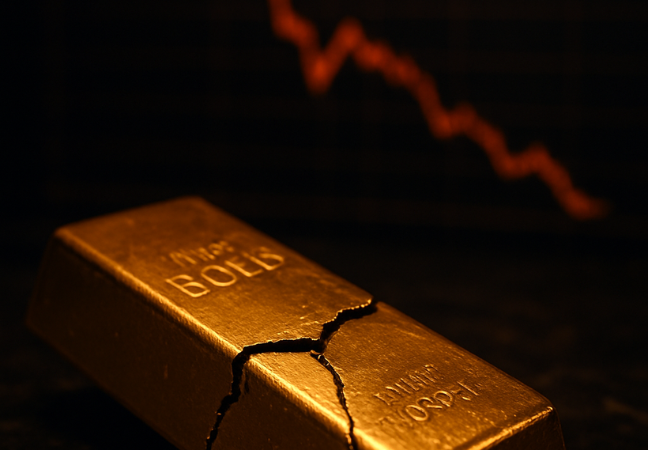
Watching gold prices decline while the prices of everything you buy rise is peculiar. The Middle East is in the midst of a conflict. The price of oil is $91.69. The US national debt has surpassed $38 trillion and is not expected to decline. Inflation won’t go away. However, since late January 2026, silver has seen one of its worst weeks since the Reagan administration, and gold has dropped almost 17% from its peak. You are not the only investor who is perplexed if you are currently staring at your screen and wondering what in the world is going on.
The good news? This is occurring for obvious, rational reasons. What’s frustrating? They are virtually unrelated to geopolitics.
The Setup: Our Climbing Height
Let’s do a thorough analysis of the scenario because understanding the magnitude of the climb will determine the magnitude of the collapse. In January 2026, gold reached an all-time high of about $5,589.38 per ounce. That was a significant step, as it followed a 66% increase throughout 2025. Usually, the rowdier brother, Silver, performed even better, increasing by about 135% in 2025 alone.
Retail investors were piling in. Institutional desks were issuing bullish notes. The story made total sense: war, debt, inflation, central banks buying gold by the ton. Everything lined up perfectly — on paper.
The fall then arrived. Gold fell to $4,657. Silver fell to about $73. For the entire year 2026, silver is now truly negative. What was altered?
- 66%—Gold’s surge in all of 2025
- 135%—Silver’s rise through 2025
- −17%—Gold’s drop from Jan 2026 ATH
Reason #1: The Fed Refused to Blink
The US Federal Reserve concluded its FOMC meeting on March 18, 2026, and maintained interest rates at 3.50% to 3.75%. That portion was anticipated. The Fed’s own forecast for rates over the next several months, known as the “dot “plot, caught investors off guard.
The markets had already predicted three rate reductions in 2026. That presumption served as the foundation for the entire gold holdings. Contrary to what the dot plot indicated, there would only be one cut for the remainder of the year. Gold plummeted as a result of just one shift in expectations.
This is the fundamental mechanism that you must comprehend. Silver and gold are assets that don’t yield. They don’t provide you with dividends or interest. The question becomes extremely straightforward when a 10-year US Treasury bond offers a secure return of 4.25% to 4.39%: why hold something that pays nothing? This is known as opportunity cost in economics. It is tremendous in a high-rate environment.
“When money is expensive to borrow, and safe assets pay real returns, gold has to fight harder to justify its place in a portfolio.”
The core logic of every rate-driven metals correction
As long as the Fed stays hawkish, this pressure on gold does not disappear. It just waits.
Reason #2: A Stronger Dollar Does the Opposite of What You’d Expect
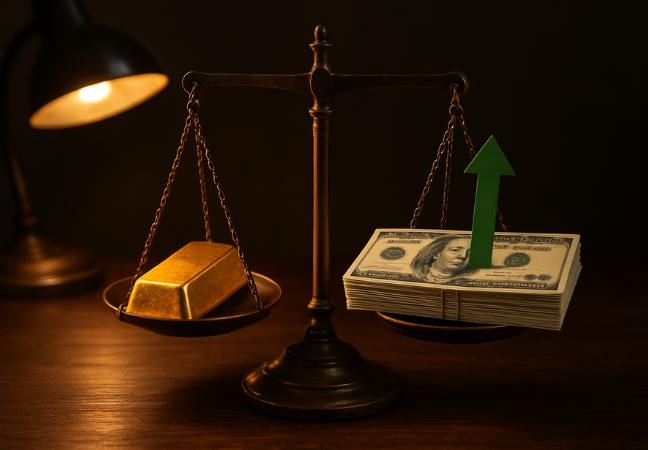
This is the section that many people find confusing. US dollars are used to determine the price of gold worldwide. Anyone who makes money in euros, yen, rupees, or any other currency will find gold more costly as the dollar strengthens. A European central bank, an Indian family office, and a Japanese pension fund all have to pay extra for the same ounce. Thus, they make fewer purchases. Demand declines. The cost decreases.
In March 2026, the dollar index reached its highest level since May of the previous year, rising above 100.2. The irony is that the exact conflict that ought to be driving up gold actually made the dollar stronger. Money flows to the world’s reserve currency as a safe haven when panic spreads around the world; even when America contributes to the chaos that initially created the anxiety, the dollar gains.
- The dollar index is above 100.2—the highest since May 2025, driven partly by Iran conflict flows.
- Non-US buyers faced higher effective prices, reducing global demand from pension funds, central banks, and retail buyers outside America.
- Safe-haven flows bifurcated—some went to gold, but a larger share went to US Treasuries and the dollar itself.
Reason #3: After a 66% Rally, Someone Always Takes Profits

Of the three, this is the most human and possibly the most crucial to internalize. What would you do as an institutional fund manager if the macro narrative abruptly changed even marginally while you were sitting on a 66% gain in gold or a 100%+ gain in silver?
You would make a sale. Not because you lost faith in gold. Not because you believed that tomorrow would be the end of the conflict. However, it makes sense to lock in a 66% gain while the Fed becomes more aggressive and the dollar appreciates. The selling turns into a cascade when many big funds do this at the same time. Prices quickly decline. Additionally, because the news appears to be bullish for gold, ordinary investors who are still reading the headlines concerning Iran and oil are left perplexed.
This represents the difference between the “situation that should make gold rise” and the “moment when gold actually rises.” Expert traders have an innate understanding of this. Everyone else learns it the hard way.
But the Bigger Story Has Not Changed
If you’re thinking beyond the next few weeks, this is what matters. The three factors causing this correction—a high currency, a hawkish Fed, and profit-taking—are all cyclical rather than structural. They come and go. For gold and silver, the underlying narrative remains largely unaltered.
- The physical shortage of silver: For the fifth year in a row, more silver has been consumed worldwide than can be produced by miners. Industrial demand for semiconductors, solar panels, and electric cars continues to rise, but supply is still limited.
- Purchases of gold by central banks—around 755 tons in 2026 alone. A one-month Fed decision does not frighten these buyers.
- Continued de-dollarization: Emerging nations are gradually and covertly moving their reserves away from the US dollar. There has been no change in this tendency. It has hardly stopped.
- JP Morgan’s year-end goal: $6,300, which would represent a 35% increase over current levels. For the end of 2026, the majority of significant institutions are grouping their projections between $5,000 and $6,500.
What You’re Watching Is a Correction Inside a Larger Rally
Hardly do markets move in a straight path. The price of gold increased from less than $2,000 to $5,600 without offering investors many opportunities to purchase at reduced costs. Even while it may seem abrupt, a 15–17% correction is really rather common following a move of that magnitude. These drops are sometimes used by structural buyers, such as central banks, sovereign wealth funds, and long-term commodities allocators, to covertly increase their holdings.
The long-term argument for gold is not at issue. It isn’t by most standards. The dilemma is, will you sell the dip only to buy back higher when confidence returns, or are you emotionally ready to endure the difficult part?
The Bottom Line
Three specific factors are causing gold and silver to decline at the moment: the Fed recently hinted at fewer rate cuts than markets anticipated; a stronger dollar is driving up the cost of metals for buyers worldwide; and institutions are taking profits following remarkable 2025 gains. These do not indicate the end of the gold narrative.
The market is overshooting on the way up, correcting, and then restarting, just like markets usually do. The structural tailwinds—de-dollarization, central bank purchases, debt levels, and the shortage of silver—remain. They are merely momentarily obscured by short-term mechanics.
The last word will go to history. However, you’ll be in a much better position to take action when gold begins to rise again if you know why it is currently declining.
This article is for educational and informational purposes only. Nothing written here constitutes financial or investment advice. Always consult a qualified financial advisor before making investment decisions.