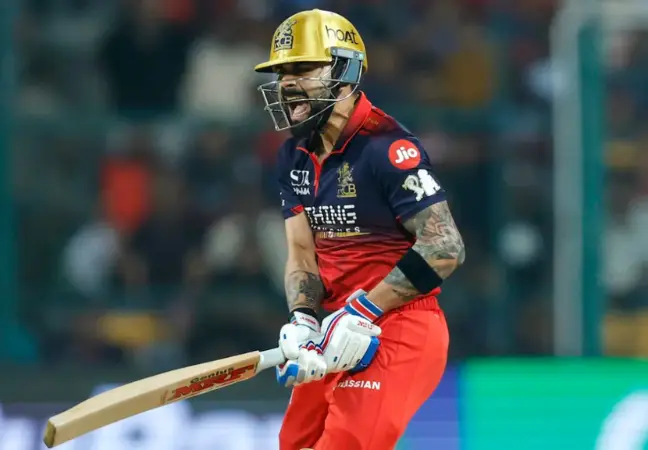
He wasn’t even meant to bat. Even yet, Virat Kohli, who was still recovering from days of sickness and a bad knee, walked out to the crease at Chinnaswamy Stadium and smashed 49 off just 34 balls.
That’s what stops you from scrolling and forces you to pay attention.
For the first time in his career, Kohli was utilized as an Impact Player by Royal Challengers Bengaluru (RCB) against Lucknow Super Giants (LSG) on Wednesday. It was an unconventional move, but it was a huge success. With 228 runs, Kohli topped the IPL 2026 run rankings as RCB won by five wickets, earning him the Orange Cap. However, the runs are not the larger picture. It’s what this incident teaches us about top athletes, mental toughness, and how winners perform even when they’re not at their best.
“Not 100%” — And Still the Best on the Field
Kohli was refreshingly candid after the game. “I’m still not fully recovered. Last game, my knee hurt a little. I’ve been sick for the past four or five days, even in terms of my health,” he said.
The majority of elite players would discreetly ignore this. Nobody would hold them accountable. However, it’s important to look closely at Kohli’s predicament because it shows something true about how elite athletes see their bodies, roles, and teams.
He missed a portion of the last RCB game against the Mumbai Indians. The group was aware that he wasn’t entirely correct. In order to safeguard him and still have access to his batting firepower when the chase started, it was most likely a deliberate choice to employ him as an Impact Player against LSG rather than in the starting XI.
It was astute handling of cricket. And when it counted most, Kohli delivered.
The Powerplay Plan: Attack First, Survive Later
RCB was chasing 147, which doesn’t seem intimidating on paper but can be challenging under pressure on a sluggish, dry ground. Kohli made a quick decision after assessing the situation: either go hard in the powerplay or run the danger of becoming bogged down.
At the top, he shot to 34 off just 14 balls. That is deliberate aggressiveness, not careless striking.
“We anticipated a dry, slow wicket,” Kohli clarified. “So the idea was to push the game away from the opposition and take the game away from them in the first five-six overs.” There is more to this lesson than just cricket. You don’t wait for difficult circumstances to worsen. When things are a little better, you grab the window, even if it means taking a chance. Kohli refused to allow the game to veer into unpredictable terrain because he knew the pitch would deteriorate as the innings progressed.
After that explosive start, he did slow down, but only because the pitch required a change of gear, not because the intention vanished.
What “Happy With My Intensity” Actually Means
Kohli’s post-match remarks included one particularly noteworthy statement: “I started off well today, so I was happy with my intensity.”
This is important for someone who is critical of themselves. Kohli is assessing his aim and methodology rather than just his runs. Elite athletes and mediocre athletes are distinguished by this conceptual framework.
Consider it this way:
- A player is stuck in outcome thinking if they score 49 and say, “I should have made a hundred,” without recognizing what went well.
- When a player states, “I was happy with my intensity,” he is evaluating himself based on execution and effort, two things he can truly influence.
- Over the course of a lengthy competition, the second perspective is significantly more enduring.
Even yet, Kohli said that he would have liked to finish the game, demonstrating his lack of complacency. However, most athletes—and, to be honest, most professionals—spend years attempting to strike a balance between self-awareness and self-accountability.
The Chinnaswamy Riddle: When Your Home Ground Becomes Unfamiliar
The pitch itself was one of Kohli’s most intriguing findings. With its large boundaries, responsive surface, and ample carry, Bengaluru’s Chinnaswamy has always been a batter’s dream. However, it played differently this time. It has been quite hot for the past three or four days. Additionally, it’s been quite dry,” Kohli said. The ball gripped and slowed due to the outfield’s lack of moisture and the surface’s thin grass, which RCB had to account for in their strategy. Casual fans frequently overlook this element. Chasing 147 on a windy, responsive surface in February is not the same as chasing 147 on a sluggish pitch with grip at the Chinnaswamy in April. One of the main reasons Kohli continues to perform is his ability to swiftly interpret these contextual cues and modify his game strategy on the fly.
The circumstances weren’t perfect. The pitch was unfamiliar. Nevertheless, RCB carried out its strategy nearly flawlessly.
The Batting Unit That Sets Everyone Free
Kohli also made a more general argument about how a strong batting lineup alters each batter’s mindset, which merits its own attention. We can play a specific style because of the way our management has assembled our team,” he stated. RCB’s middle and lower order is quite terrifying, with finishers like Romario Shepherd and Tim David accessible down the order, and Krunal Pandya hardly having faced a delivery yet. They have two players who can score fifty runs in four overs, even when they are five wickets behind. For an opening, what does that accomplish? The concern of wasting your wicket is eliminated. You can play more freely if you know that someone can save the innings even if you fall for thirty. You take a more aggressive stance against the power play. When the pressure increases, you don’t freeze.
It’s a psychological technique for team development. And it’s obviously working because RCB is leading the IPL 2026 standings.
Rajat Patidar: Assessing the Bowler’s Heart Rate, Not the Situation
When his skipper, Rajat Patidar, smacked three sixes in a scorching 13-ball 27, Kohli made an amazing comment. “I always tell him, you’re probably looking to assess the bowler’s heart rate rather than the situation.”
Even though it was spoken with a laugh, it conveys a genuine feeling. The only two IPL 2026 hitters with 200 or more runs with 200 or more strike rates are Patidar and Vaibhav Sooryavanshi. Instead of waiting for a poor ball, the hitter uses a certain level of aggressiveness to transform quality deliveries into scoring opportunities, resulting in that incredible mix of volume and rate.
T20 Has Changed — But the Smarts Still Matter
One of Kohli’s most insightful remarks was regarding how quickly T20 cricket has changed and if the sport still has space for slower, more traditional values.”Not every game will be 230 or 240,” he stated. “The strain starts when the freedom disappears. At that point, the game’s intelligence must be used.”
Kohli is subtly refuting the notion that sheer power is the only factor in the current T20. He contends that cricket intelligence and situational awareness will distinguish the teams that advance from those that fail during the playoff stages, when every game matters, bowlers prepare better, and pressure is at its peak. He has the data to support that opinion. A 37-year-old with a painful knee just topped the run charts in a sport that increasingly emphasizes youth and muscle. That is evidence, not nostalgia.
What Every Cricket Fan (and Sportsperson) Can Learn From This
There are several lessons to be learned from Kohli’s performance and remarks that extend well beyond cricket:
- Being present is more important than feeling prepared. Kohli might have taken a nap. Rather, he modified his position as an Impact Player while still performing well.
- Before creating a plan, read the conditions. Not every circumstance needs the same strategy. Everything counts, including the pitch, the weather, and the strengths of the enemy.
- Evaluate effort rather than just outcomes. “Happy with my intensity” — not “happy with my score”. That’s a positive, performance-oriented way of thinking.
- Individual freedom is produced by team depth. You can play fearlessly when you have faith in those around you. This is true in every workplace, including sports.
The Chase Isn’t Over — It’s Just Getting Started
With Kohli wearing the Orange Cap, RCB is leading the IPL 2026 standings and appears to be a serious contender for the championship. However, the competition is just halfway over, as Kohli himself admitted. There will be more pressure, narrower margins, and a more difficult second half.
Wednesday demonstrated that this version of Kohli is adept at finding a solution even in situations where conditions, fitness, and format aren’t ideal, not just by force, but also by mental clarity, faith in his teammates, and an unwavering will to compete. He is among the best T20 hitters of his generation because of this more than any knock.
With Kohli at his peak, IPL 2026 will be much more fascinating. Let’s hope the knee holds up.
Also Read: AI Agents Are Taking Over Your To-Do List
We recommend checking this detailed guide for more clarity: Kohli not at 100% fitness but ‘happy with my intensity.’