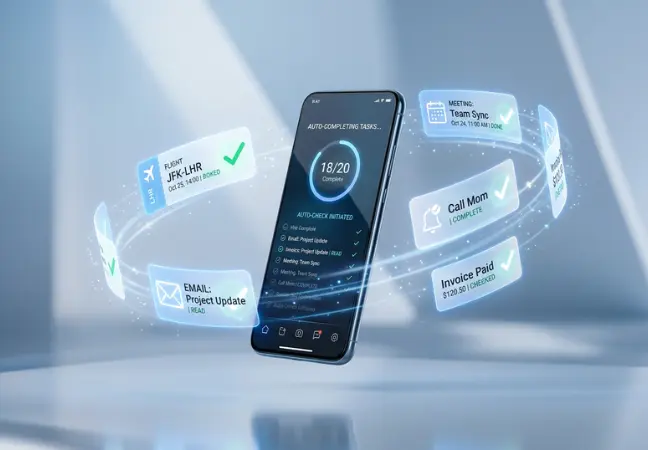
AI agents are silently performing activities that you used to do yourself, such as scheduling your flights and repairing your code. Here’s what they really are and why everything will change in 2026.
When you wake up, picture asking your phone to “plan a weekend trip to Goa under ₹15,000.” Without you ever using a booking website, it returns an hour later with flights, a hotel, a daily schedule, and even a list of eateries close to your hotel.
It’s not science fiction. AI agents are that. And they’ve already arrived.
While the majority of people continue to use AI as a smarter search engine—type a query, receive an answer—a much more significant change is taking place in the background. AI is learning to accomplish tasks rather than merely provide answers. And this distinction? Everything is altered by it.
So What Exactly Is an AI Agent?
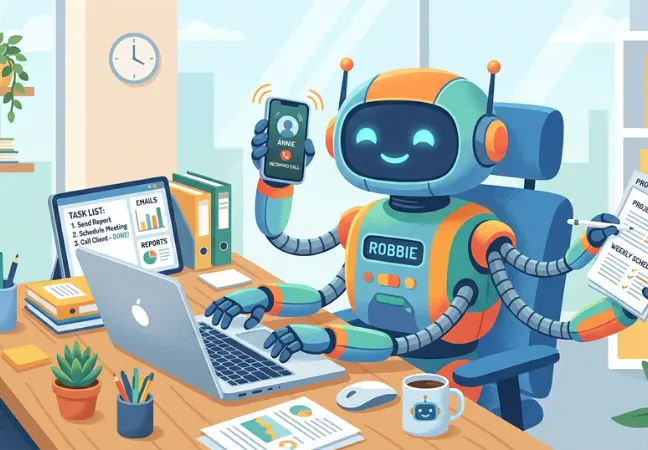
As put simply, a typical AI chatbot can be compared to an extremely intelligent buddy who offers wise counsel. Similar to that same friend, an AI agent can now make calls, send emails, complete forms, and notify you when they’re finished.
Technically speaking, an AI agent is a system that can take an objective, break it down into parts, use tools and data to accomplish those steps, and independently modify its strategy when anything goes wrong.
“AI is shifting from individual usage to team and workflow orchestration — coordinating entire workflows, connecting data across departments, and moving projects from idea to completion.” — IBM Think, 2026
The key ingredient here is autonomy. The agent doesn’t wait for you to approve each step. It figures out the path and walks it. You just see the result.
A Real-Life Example That Makes It Click
A small company owner may instruct an AI agent to “follow up with all clients who haven’t replied to my emails in the last two weeks.”
A standard AI would create a template that you could copy and paste. An AI agent would:
- Look through your inbox to locate any open email threads.
- Using the context from the initial email, create a customized follow-up for every client.
- Plan and deliver those emails at the most convenient moment for each recipient.
- Mark every client as “follow-up sent” by updating your CRM.
- For your review, mark those who haven’t responded after three days.
One instruction was given by you. Twelve steps were managed by the agency. People still don’t completely understand that transition.
Why Is This Happening Right Now in 2026?
AI agents are not a novel concept. For decades, researchers have discussed them. Why, therefore, are they truly becoming popular in 2026?
The models become sufficiently intelligent.
Previous AI systems were only capable of doing one task at a time, such as creating text, identifying pictures, or responding to inquiries. Because modern AI is multimodal, it can simultaneously read text, view images, listen to voice, and comprehend charts. Because of this, it can manage the chaotic, disorganized character of work found in the actual world.
They are now able to employ tools.
Today’s AI can communicate with your apps. It can read a spreadsheet, send a message, call an API, start a browser, conduct a search, and fill out a form. When you combine it with intellect, you have an employee who never sleeps and never typos.
Multiple agents can collaborate.
This is the truly astounding portion. It is now possible for one AI agent to delegate a job to another AI agent with a distinct area of expertise. Imagine it as a group of professionals, with one person in charge of research, another of writing, and a third of scheduling. However, the entire “team” is made up of software that manages itself.
Where You’re Already Seeing AI Agents in Action
It’s possible that you unknowingly utilized an AI agent. They are currently employed at the following locations:
- Chatbots for customer service that not only respond to inquiries but also handle refunds or provide real-time order status updates.
- AI coding assistants that reduce development time from days to hours by writing, testing, debugging, and deploying code, in addition to making suggestions.
- Intelligent email programs that automatically unsubscribe from junk mail, prioritize your inbox, and prepare responses.
- Apps for shopping and travel that enable you to apply discounts, compare costs across platforms, and finish the checkout process.
AI is already used in Amazon’s warehouses to manage robot fleets. Automobiles in BMW facilities drive themselves along manufacturing lines. It’s not as long as you may expect to go from manufacturing floors to your smartphone.
What This Actually Means for You
The harsh reality is that AI agents won’t “replace jobs” in the spectacular, overnight manner that headlines like to claim. However, they will drastically and swiftly alter how work is completed.
Time will be the most useful influence on regular people. Research, comparison, scheduling, and response tasks that took thirty minutes will be reduced to a brief prompt. The agent becomes the executor, and you become the decision-maker.
This is a true superpower for small company entrepreneurs. Without the need for additional employees, an AI agent may manage your customer emails while you sleep, produce your weekly report on Monday morning, and remind you to follow up on delinquent payments.
The most exciting shift is the democratisation of AI agent creation — the ability to design and deploy intelligent agents is moving beyond developers into the hands of everyday business users.
The Part Nobody Talks About: Trust and Control
This is when things become complicated. Giving an AI the ability to act on your behalf is both very helpful and a bit unsettling. What happens if the incorrect email is sent? Purchased the incorrect flight? removes something crucial?
Because of this, the most effective AI agent systems are constructed using a “human-in-the-loop” methodology. The agent takes care of the tedious tasks, but it highlights crucial choices for your approval. You are promoted to the stage that genuinely calls for human judgment rather than being cut out of the process.
Avoid thinking “the robot does everything” and instead think “the robot does the boring parts, and asks you about the important ones.” Working with these systems in this way is both practical and healthful.
Should You Start Using AI Agents Today?
Here’s a quick place to start if you’ve never looked into this area: agent-like functions are already built into programs like Microsoft Copilot, Notion AI, and Google’s AI-powered applications. To utilize them, you don’t have to be a developer.
Begin modestly. Try assigning one repetitive duty to an AI tool for a week, such as creating weekly reports, summarizing emails, or writing answers. Take note of what it does well and where you still need to intervene. You will learn more from that experience than from any article.
The technology is no longer in the future. Right now, it’s in your hands. The only question is whether you’ll utilize it or let someone else use it while you continue to perform tasks by hand.
The Bottom Line
The most significant change in our usage of technology since the smartphone is represented by AI agents. They transform AI from an informational tool to one that takes action on your behalf. That’s a really different kind of relationship, and it creates opportunities that most people can only dream about.
It doesn’t need you to comprehend the underlying code. All you need to know is that AI is now capable of doing more than merely saying things. Knowing that already puts you ahead of the majority of people.
Also Read: Agentic AI in 2026: How Multi-Agent Systems Are Quietly Replacing Human Workflows